Self-Learning Agents Reference Architecture
Overview
Self-learning agents represent the next evolution in AI systems - agents that can autonomously improve their capabilities, learn from experience, and evolve without requiring human-annotated data. These systems implement sophisticated feedback loops and co-evolutionary frameworks to continuously enhance their performance.
Agent0 Series: Self-Evolving Agents from Zero Data
Framework Overview
Agent0 is a reference framework built by Stanford Research that demonstrates a fully autonomous, iterative co-evolutionary approach to enhancing LLM agent capabilities without relying on any human-annotated data.
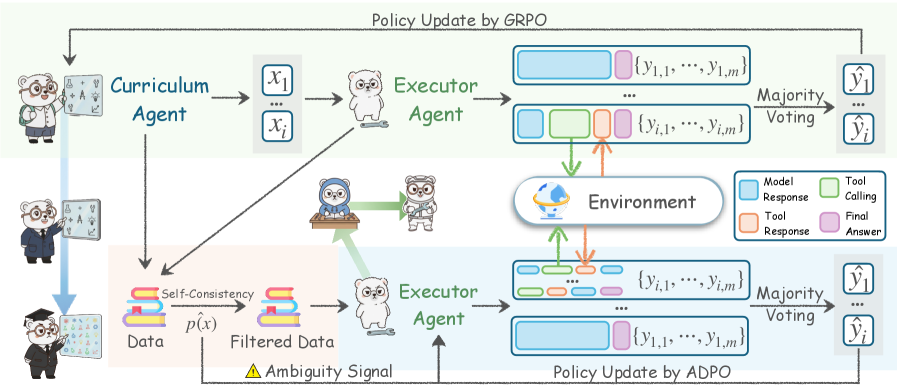
Agent0 Co-evolutionary Framework Architecture
Core Architecture
Dual-Agent Co-Evolution System
Agent0 implements a sophisticated two-agent system where both agents evolve together:
1. Curriculum Agent (π_θ) - Purpose: Generate frontier tasks that are appropriately challenging - Technology: Reinforcement Learning (RL) based optimization - Objective: Create progressively more complex tasks for the Executor Agent - Evolution: Learns to generate tasks at the optimal difficulty level
2. Executor Agent (π_φ) - Purpose: Solve increasingly complex tasks proposed by Curriculum Agent - Technology: Task-specific learning and adaptation - Objective: Maximize success rate on generated tasks - Evolution: Improves problem-solving capabilities through practice
Co-Evolutionary Feedback Loop
At the core of this framework are two functionally distinct agents initialized from the same base LLM:
- Curriculum Agent (π_θ): Using RL, aims to generate frontier tasks that are appropriately challenging for the current Executor Agent
- Executor Agent (π_φ): Aims to solve the increasingly complex tasks proposed by the Curriculum Agent
The agents engage in a continuous co-evolutionary process where the Curriculum Agent learns to create tasks at the optimal difficulty level while the Executor Agent develops enhanced problem-solving capabilities.
Agent0-VL: Multimodal Extension
Enhanced Capabilities
Agent0-VL extends the self-evolution paradigm to multimodal reasoning tasks by incorporating tool usage into multiple aspects of the learning process:
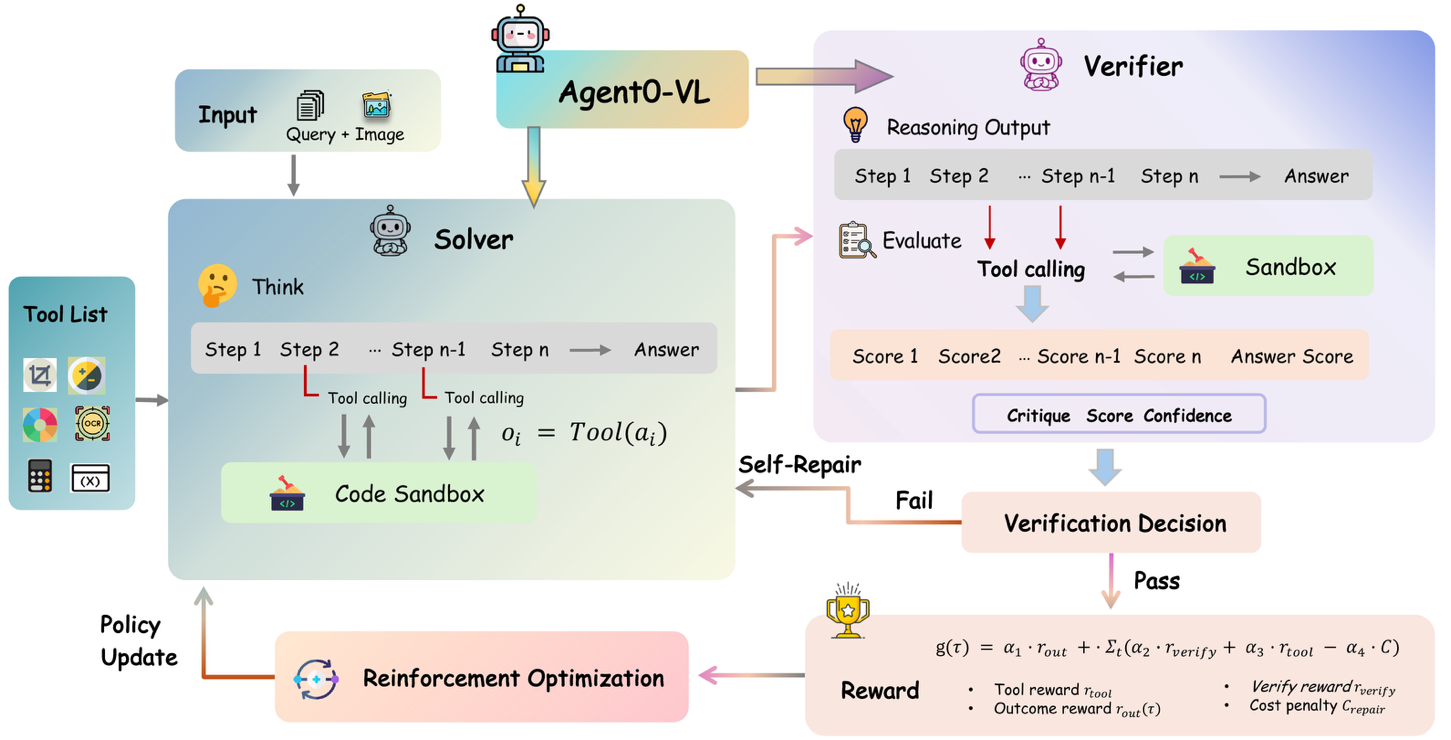
Agent0-VL Multimodal Self-Evolution Architecture
Key Innovations
1. Tool-Integrated Reasoning - Tools are used not just for task execution but also for reasoning - Multimodal tool integration for vision and language tasks - Dynamic tool selection based on task requirements
2. Self-Evaluation with Tools - Agents use tools to evaluate their own performance - Automated quality assessment without human intervention - Continuous feedback loop for improvement
3. Self-Repair Mechanisms - Automatic error detection and correction - Tool-assisted debugging and problem resolution - Iterative refinement of solutions
Agent0-VL incorporates tool usage not only into reasoning but also into self-evaluation and self-repair, creating a comprehensive self-improving system for multimodal tasks.
Implementation Patterns
Curriculum Generation Strategy
Task Generation Process:
  1. Difficulty Assessment:
     - Analyze current executor capabilities
     - Identify skill gaps and improvement areas
     - Generate tasks at optimal challenge level

  2. Task Diversification:
     - Create varied task types and domains
     - Ensure comprehensive skill development
     - Maintain engagement and learning momentum

  3. Progressive Complexity:
     - Gradually increase task difficulty
     - Build upon previously mastered skills
     - Introduce new concepts systematically
Executor Learning Process
Learning Cycle:
  1. Task Reception:
     - Receive task from curriculum agent
     - Analyze requirements and constraints
     - Plan solution approach

  2. Solution Execution:
     - Apply current capabilities and tools
     - Implement solution strategies
     - Monitor progress and adapt as needed

  3. Performance Evaluation:
     - Assess solution quality and effectiveness
     - Identify areas for improvement
     - Update internal knowledge and strategies

  4. Capability Enhancement:
     - Integrate lessons learned
     - Refine problem-solving approaches
     - Prepare for more complex challenges
Technical Specifications
Framework Components
1. Task Generation Engine - Dynamic difficulty adjustment algorithms - Multi-domain task creation capabilities - Performance-based curriculum adaptation - Diversity maintenance mechanisms
2. Execution Environment - Sandboxed task execution space - Tool integration and management - Performance monitoring and logging - Safety and security controls
3. Evaluation System - Automated performance assessment - Multi-criteria evaluation metrics - Progress tracking and analytics - Feedback generation for both agents
4. Learning Infrastructure - Model parameter optimization - Experience replay and storage - Knowledge transfer mechanisms - Continuous improvement pipelines
Use Cases and Applications
Research and Development
- Automated Research: Self-improving research agents
- Scientific Discovery: Autonomous hypothesis generation and testing
- Literature Analysis: Evolving understanding of research domains
- Experimental Design: Self-optimizing experimental protocols
Software Development
- Code Generation: Self-improving coding capabilities
- Bug Detection: Evolving debugging and testing skills
- Architecture Design: Autonomous system design improvement
- Performance Optimization: Self-tuning optimization strategies
Problem Solving
- Complex Reasoning: Multi-step logical problem solving
- Creative Tasks: Evolving creative and innovative capabilities
- Strategic Planning: Long-term planning and strategy development
- Adaptive Decision Making: Context-aware decision optimization
Implementation Guidelines
Setup and Configuration
1. Environment Preparation
# Install required dependencies
pip install agent0-framework torch transformers

# Configure base models
export CURRICULUM_MODEL="gpt-4"
export EXECUTOR_MODEL="gpt-4"
export EVALUATION_MODEL="gpt-4"
2. Framework Initialization
from agent0 import CurriculumAgent, ExecutorAgent, CoEvolutionFramework

# Initialize agents
curriculum_agent = CurriculumAgent(model="gpt-4")
executor_agent = ExecutorAgent(model="gpt-4")

# Create co-evolution framework
framework = CoEvolutionFramework(
    curriculum_agent=curriculum_agent,
    executor_agent=executor_agent,
    evolution_cycles=1000
)
3. Training Process
# Start co-evolution process
results = framework.evolve(
    initial_tasks=seed_tasks,
    evaluation_metrics=["accuracy", "efficiency", "creativity"],
    convergence_criteria={"min_improvement": 0.01}
)
Best Practices
1. Curriculum Design - Start with simple, well-defined tasks - Ensure gradual difficulty progression - Maintain task diversity across domains - Include both success and failure cases
2. Evaluation Metrics - Define clear, measurable success criteria - Include both quantitative and qualitative measures - Monitor learning progress and convergence - Implement safety and ethical constraints
3. Safety Considerations - Implement robust sandboxing for task execution - Monitor for harmful or unintended behaviors - Include human oversight and intervention capabilities - Maintain audit trails for all learning activities
Research Foundation
Academic Papers
- Original Paper: Agent0: Self-Evolving Agents from Zero Data
- Stanford Research: AIMING Lab Agent0 Project
- Multimodal Extension: Agent0-VL research and implementation
Key Contributions
- Demonstration of zero-data self-evolution
- Co-evolutionary framework for agent improvement
- Multimodal reasoning with tool integration
- Automated curriculum generation and adaptation
Future Directions
Emerging Capabilities
- Multi-Agent Co-Evolution: Extending to multiple interacting agents
- Domain Transfer: Learning across different problem domains
- Meta-Learning: Learning how to learn more effectively
- Emergent Behaviors: Discovering novel problem-solving approaches
Research Opportunities
- Scalability: Handling larger and more complex problem spaces
- Efficiency: Reducing computational requirements for evolution
- Interpretability: Understanding the learning and evolution process
- Safety: Ensuring beneficial and aligned self-improvement
Anthropic: Dreaming and Outcomes as Production Self-Learning
Anthropic's May 2026 Claude Managed Agents release provides a production-ready, non-RL implementation of self-learning that contrasts with Agent0's co-evolutionary approach:
| Dimension | Agent0 (Stanford, 2025) | Claude Managed Agents (Anthropic, 2026) |
|---|---|---|
| Learning mechanism | RL-based co-evolution between curriculum and executor agents | Scheduled memory consolidation (dreaming) + self-grading loop (outcomes) |
| Training requirement | Requires co-evolution training cycles | No retraining — improvement through memory consolidation only |
| Feedback signal | Task success rate across curriculum | Developer-authored rubric evaluated by isolated grader agent |
| Memory model | Model weights updated via RL | Filesystem-based text memory, updated between sessions |
| Improvement granularity | Model-level generalization | Session-to-session memory updates |
| Production availability | Research framework | Managed cloud API (public beta + research preview) |
Dreaming Loop (Anthropic)
- Agent executes task, writes episodic memory during the session
- Outcomes evaluator (separate context) scores result against rubric; agent iterates
- Dreaming runs between sessions: reviews episodic logs, extracts patterns, removes stale facts, consolidates procedural improvements
- Next session inherits enriched memory — no model retraining required
This is the first major first-party productization of the Reflection/Consolidation LTM strategy from the CoALA taxonomy at scale, with documented ~6× task completion gains (Harvey, legal AI, May 2026).
Related Architectures
- AI Automation: For structured workflow automation
- AI Assistant Architecture: For interactive assistant systems
- Multi-Agent Systems: Advanced coordination patterns
- Claude Managed Agents: Production dreaming and outcomes implementation
- Long-Term Memory Strategies: Memory consolidation strategies
See Also
- Claude Managed Agents
- Long-Term Memory Strategies
- Agent Memory Management
- LifeOS — personal AI operating system implementing a seven-phase self-improvement loop (OBSERVE→THINK→PLAN→BUILD→EXECUTE→VERIFY→LEARN)
- FreePHDLabor — dynamic multiagent framework for continual, automated scientific research
- Discovery Loop — commercial platform for large-scale parallel automation of ML research and science