7.8 RAG Implementation
RAG Architecture (Huyen, 2025)
A RAG system has two core components:
- Retriever: Processes external memory sources via two functions — indexing (preparing data for fast retrieval) and querying (ranking documents by relevance to a given query)
- Generator: A foundation model that produces a response based on the query plus the retrieved context
In modern RAG systems these components are typically trained separately. Finetuning the whole RAG system end-to-end (retriever + generator jointly) can improve performance significantly but is less common.
Retrieval Algorithms
Retrieval is the backbone of RAG. The choice of algorithm determines quality, cost, and latency:
| Algorithm Type | How It Works | Best For |
|---|---|---|
| Keyword (BM25/TF-IDF) | Scores documents by term frequency and inverse document frequency | Exact match; technical terms; legal/compliance text |
| Dense retrieval (vector search) | Embeds query and documents; retrieves by cosine/dot-product similarity | Semantic similarity; paraphrases; concept search |
| Hybrid | Combines keyword + dense scores (typically via RRF or weighted sum) | General-purpose; balances exact and semantic match |
| Sparse + dense (SPLADE, ColBERT) | Learned sparse representations; dense interaction at query time | High recall with interpretability |
| Re-ranking | A second-pass cross-encoder scores the top-k retrieved chunks for final ranking | Improving precision after first-pass retrieval |
Retrieval Optimization
Key strategies for improving retrieval quality:
- Chunking strategy: Splitting documents into workable chunks is a core design decision. Chunk size and overlap affect both recall and context length. Common approaches: fixed-size chunks, sentence-level chunks, semantic chunking (split at topic boundaries).
- Query expansion: Rewrite or augment the user query to improve recall (hypothetical document embeddings, multi-query retrieval)
- Metadata filtering: Attach and filter by document metadata (date, source, category) to reduce irrelevant retrievals
- Contextual compression: After retrieval, extract only the passages most relevant to the specific query rather than including whole chunks
- Embedding model selection: The embedding model is as important as the retriever algorithm. Domain-specific finetuned embeddings outperform general models on specialized corpora.
RAG vs. Full-Context Prompting vs. Finetuning
| Approach | When to Use |
|---|---|
| RAG | External knowledge not in model weights; needs to stay current; large/proprietary document sets |
| Full-context prompting | Knowledge fits in context window; latency tolerant; no need to maintain an index |
| Finetuning | Style/format adaptation; domain specialization; recurring task patterns |
RAG and finetuning are complementary: RAG provides current knowledge retrieval; finetuning adapts the model's behavior and style. Both can (and often should) be used together.
Search as Code (SaC)
An emerging paradigm where language models generate code to assemble task-specific retrieval pipelines on demand, rather than routing through fixed pipelines. See Search as Code for Perplexity's full architecture — Models as Control Plane, Compute Sandboxes, and Agentic Search SDK — including the WANDR benchmark and CVE case study showing 85.1% token reduction.
RAG Engines
- Contextual AI RAG Agents: enterprise solution for building and deploying specialized RAG agents with Reranker
- Gigaspaces eRAG
Retrieval Approaches
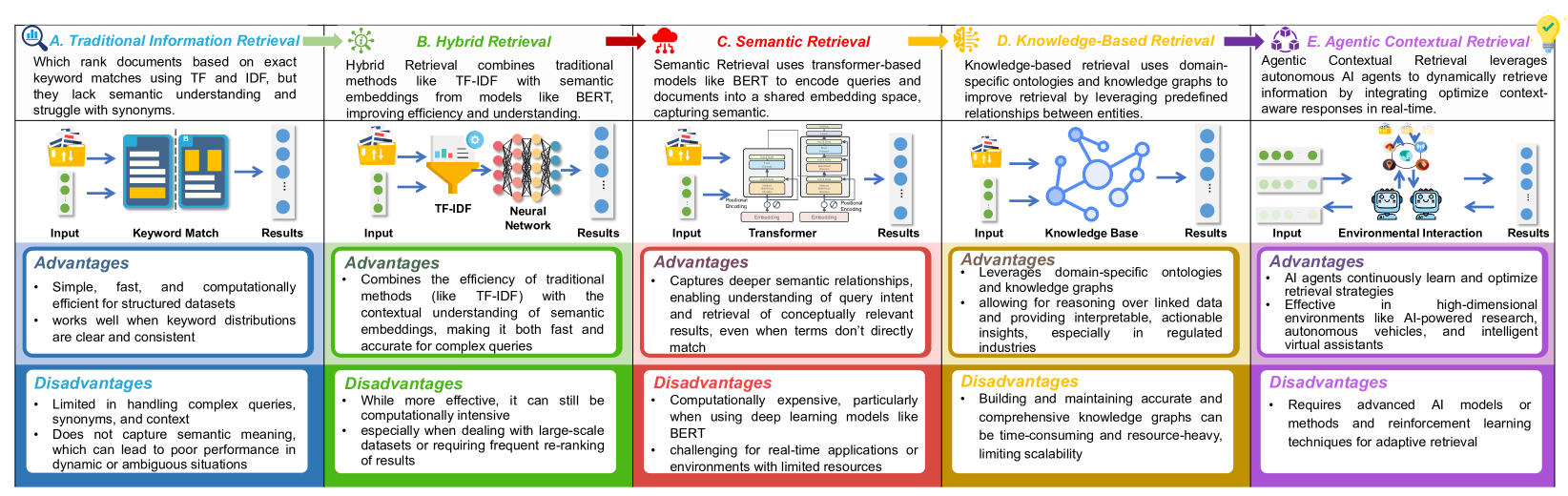
Comparison of Key Retrieval Strategies:
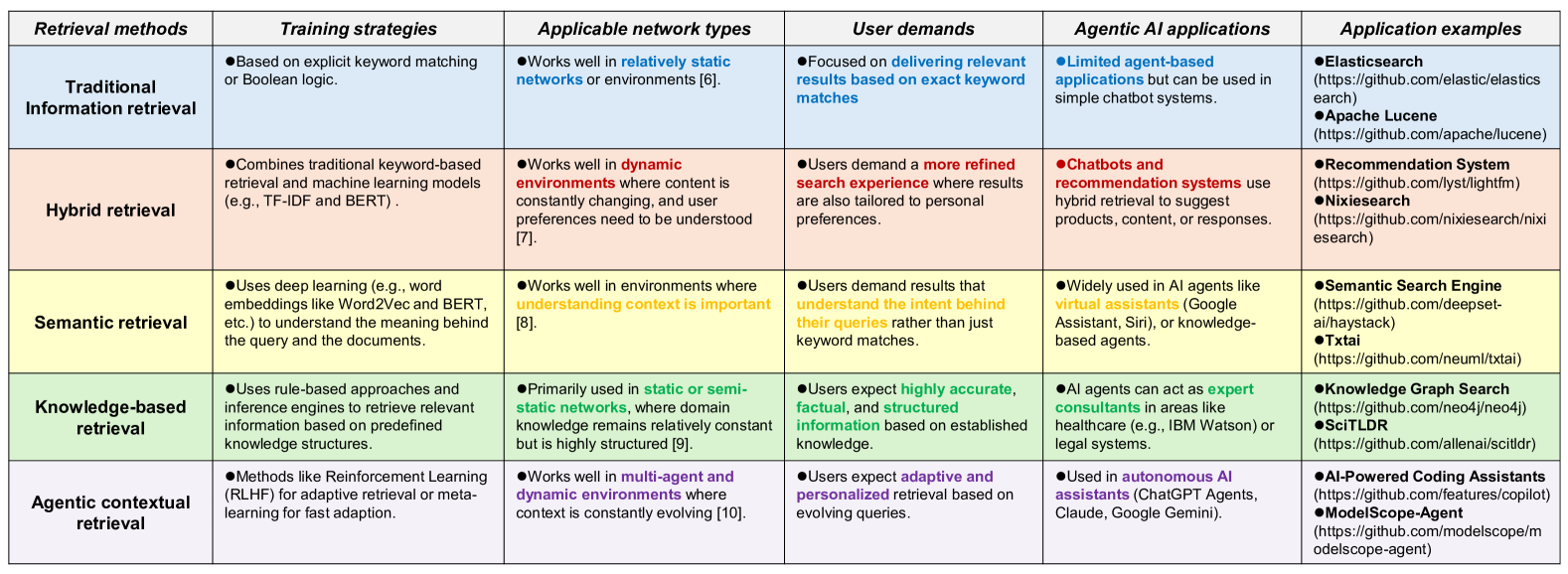
Agentic contextual retrieval:

Fine-tuning Models for RAG
- Databricks - Improving Retrieval and RAG with Embedding Model Finetuning
- Fine-tuning Embedding Model Reference
See Also
- AI Engineering Architecture
- Context Engineering Strategies
- RAG Reference Architecture
- Search as Code
- Semantic Data Layer Technology Radar
References
- AI Engineering: Building Applications with Foundation Models — Chip Huyen, O'Reilly, 2024. Chapter 6.