State & Memory Management
Effective memory management determines whether an agent feels like a persistent, intelligent system or a stateless chatbot. The core challenge is deciding what to keep in the expensive context window versus what to offload to external storage.
Overview
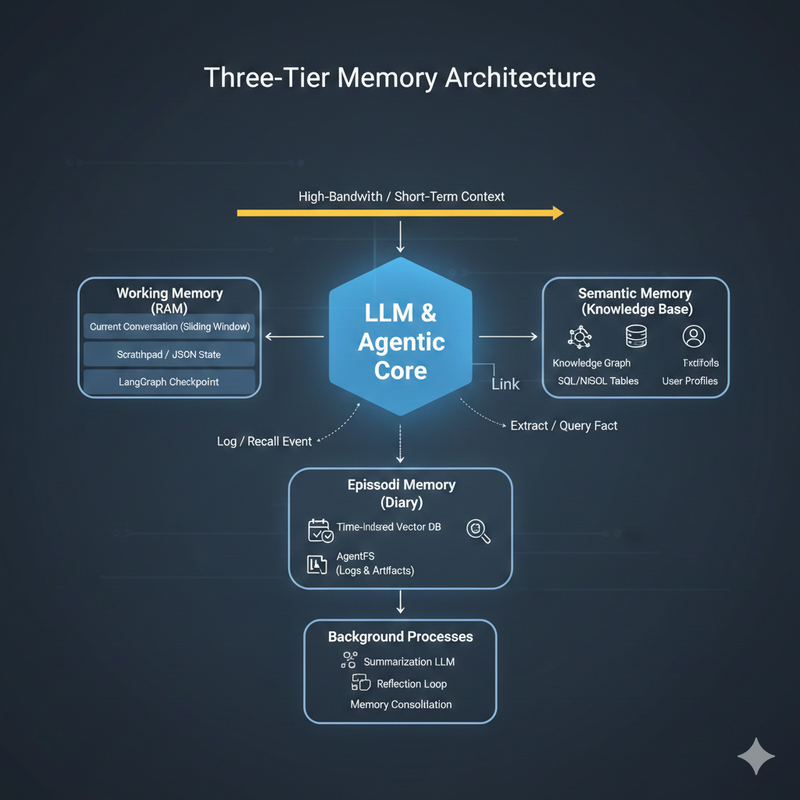
Agent memory operates across three functional tiers:
| Tier | Purpose | Storage | Analogy |
|---|---|---|---|
| Short-term (Working Memory) | Current task context and conversation flow | In-memory / checkpointer | RAM |
| Episodic Memory | Searchable log of past events and outcomes | Vector DB / structured logs | Journal |
| Long-term (Semantic Memory) | Persistent facts, preferences, and learned rules | Knowledge graph / SQL | Hard drive |
Best Practices
| Key Challenge | Description | Lessons Learned & Alternatives Considered | Solution Applied |
|---|---|---|---|
| Context window overflow | Long sessions exceed model token limits, causing truncation or errors | Tried increasing context window size; costs scaled quadratically | Implement sliding window or recursive summarization to compress old history |
| State loss between sessions | Agents forget user preferences and prior decisions across sessions | Stored full conversation history; retrieval became slow and noisy | Extract and persist key facts (entity extraction) to a structured store; retrieve on demand |
| Conflicting memory updates | Multiple agents writing to shared memory create inconsistencies | Used a single shared vector DB; concurrent writes caused stale reads | Implement optimistic locking or event-sourced memory with a temporal knowledge graph (Zep/Graphiti) |
| Memory retrieval relevance | Fetching too much irrelevant context degrades response quality | Retrieved top-K by embedding similarity alone; pulled in unrelated facts | Combine semantic search with metadata filters (recency, entity type, session ID) |
| Memory privacy and isolation | User A's memory leaking into User B's context | Shared embedding space across users; namespace collisions occurred | Enforce strict tenant/user namespacing in all memory stores; audit access patterns |
| Implicit vs explicit memory | Agents miss important facts not explicitly stated by users | Relied on users to say "remember this"; most didn't | Run a background extraction LLM to monitor conversations and auto-save key facts |
| Memory staleness | Stored facts become outdated as user context changes | Kept all facts indefinitely; agents acted on stale preferences | Attach TTLs to volatile facts; use temporal graphs to track how facts evolve over time. For managed platforms, use scheduled dreaming (Anthropic) to auto-purge contradicted facts between sessions |
| Working memory for tool-heavy tasks | Complex multi-step tool chains lose intermediate state | Passed all state through the context window; hit token limits | Use a scratchpad / AgentFS for intermediate tool outputs; reference by pointer in context |
| Self-improvement without retraining | Agent makes same mistakes across sessions without model fine-tuning | Manual rule updates in system prompt; engineers couldn't keep up | Use scheduled memory consolidation (dreaming) to extract recurring patterns from episodic logs and promote them to procedural memory automatically |
| Self-evaluation of agent output quality | Hard to know if agent succeeded without human review | Spot-checking a sample; missed regressions | Add an isolated grader agent (Outcomes pattern) that scores output against a plain-language rubric in a separate context window; loop until grader approves or max iterations reached |
| Scheduled/automated loops losing continuity between runs | A recurring automation (cron, /loop, /goal) has no memory of what a prior run already tried or resolved |
Re-ran the same triage prompt from scratch each morning; duplicated work and re-surfaced resolved findings | Externalize loop state to a markdown file or tracker board (e.g., Linear via MCP) that records what's done and what's next — the agent forgets between runs, the repo/tracker doesn't; see Loop Engineering |
Memory Solutions Reference
| Solution | Provider | Core Technology | Key Strength |
|---|---|---|---|
| Mem0 | Independent | Vector + Graph | Auto-extracts and refines user facts across sessions |
| Zep | Independent | Temporal Knowledge Graph | Tracks how facts evolve over time |
| AgentFS | Turso | SQLite-backed virtual FS | Filesystem-like persistence in a single portable .db file |
| Letta (MemGPT) | Independent | Virtual Context | Self-managed RAM/disk for autonomous context swapping |
| LangMem | LangChain | Managed SaaS | Deep integration with LangGraph nodes |
| Claude Managed Agents Memory + Dreaming | Anthropic | Filesystem + scheduled consolidation | First-party self-improving memory with dreaming (between-session consolidation) and outcomes (self-grading); Harvey reported 6× task completion gains |
| Bedrock Memory | AWS | Managed AWS | Enterprise scaling and compliance for Bedrock agents |
LTM Strategy Selection
| Strategy | Best For | Storage |
|---|---|---|
| Vector RAG | Fuzzy/semantic search over large knowledge bases | Pinecone, Chroma, pgvector |
| Knowledge Graph | Relational reasoning, multi-hop questions | Neo4j, FalkorDB |
| Entity Extraction | Personalization, fixed attributes (allergies, preferences) | Postgres, Redis |
| Incremental Summary | Long-term narrative without storing every message | Markdown / text files |
| Reflection / Consolidation | Self-correction, learning from past failures | AgentFS / specialized DB |
Stateless Agent Design for Horizontal Scaling
Since LLMs are themselves stateless, persisting memory externally is non-negotiable for production agents. The payoff: any agent instance can handle any request, enabling serverless horizontal scaling.
Google Cloud pattern: Design agent logic as a stateless, containerized service with external state — deployable on Cloud Run (auto-scaling) or Vertex AI Agent Engine.
Key architectural choice: - Vertex AI Agent Engine: Provides a built-in, durable session and memory service. Managed, but less flexible. - Cloud Run + external DB: More flexibility — integrate directly with AlloyDB or Cloud SQL. Requires managing the persistence layer yourself.
Handling long-running tasks: For complex jobs, use asynchronous/event-driven patterns. A service publishes a task to Pub/Sub, which triggers a Cloud Run worker for asynchronous processing. The agent stays responsive while the job runs in the background.
Reliability for stateful tools: When a tool call fails (network issue, transient error), agents must retry safely. This requires: - Idempotent tools: Tools designed so calling them twice with the same inputs doesn't cause duplicate side effects (e.g., duplicate charges, duplicate messages). Critical for tools involving financial transactions or external writes. - Exponential backoff: Automatically retry with increasing delays, giving the downstream service time to recover.
Multi-Agent Shared State (AWS Pattern)
In multi-agent systems, agents coordinate through shared state rather than direct coupling. AWS recommends a three-tier shared state architecture:
| Tier | Store | Characteristics | Use For |
|---|---|---|---|
| Task state | Amazon DynamoDB | Single-digit ms reads, survives agent failures, full audit trail | Durable workflow execution state — every step recorded |
| Session context | Amazon ElastiCache | Sub-ms access, TTL-managed | Conversation turns + recently accessed payloads |
| Domain knowledge | Amazon Bedrock Knowledge Bases | Vector retrieval, governance-controlled, shared across all agents | No duplication of knowledge across agent instances |
| Intermediate results | Amazon S3 | Cost-effective, durable | Referenced by pointer in DynamoDB task state — never forwarded in payloads |
Handoff payload principle: include only what the next agent needs. Verbose payloads bloat context windows and degrade reasoning quality. Store large intermediate artifacts in S3 and pass a reference, not the content.
Memory Governance: Lineage, Retention, PII, Right-to-Delete
Memory stores accumulate sensitive data under regulatory obligation. Governance must be built in at design time, not added retroactively.
Data Lineage
Every memory write should emit an audit record with: session_id, agent_id, user_id, timestamp, source_ip. Tag all memory records with {tenant_id, data_classification, retention_class}.
| Store | Lineage Mechanism |
|---|---|
| All memory writes | AWS CloudTrail API records |
| Workflow state changes | Amazon DynamoDB Streams (audit replay) |
| S3 knowledge base records | Amazon S3 object metadata (document source) |
Retention Policies by Tier
| Tier | Store | Recommended TTL | Notes |
|---|---|---|---|
| Session | Redis / ElastiCache | 24h default | Sessions older than 24h are stale; aggressive TTL frees DRAM |
| Workflow | DynamoDB | 90 days | Step Functions execution logs: 90-day retention |
| Long-term | MongoDB Atlas | Per-tenant configurable via expireAfterSeconds |
Fields: timestamp |
| Knowledge base source docs | Amazon S3 | Glacier after 1 year, delete after 7 years | S3 Lifecycle rules |
PII Detection and Handling
Apply Amazon Bedrock Guardrails PII filter in the consolidation Lambda before any write to long-term stores. Configurable modes: detect-and-mask vs. detect-and-block. PII types covered: name, SSN, email, credit card, IP. Use field-level encryption in MongoDB Atlas for PII-bearing fields with KMS-managed keys. Scan S3 source buckets with Amazon Macie before knowledge base sync jobs ingest documents.
Right-to-Delete (GDPR/CCPA)
Indexed user_id on each memory store tier enables targeted purge without full-table scans:
| Store | Deletion Approach |
|---|---|
| MongoDB Atlas | deleteMany({user_id: X}) via user_id index |
| DynamoDB | GSI on user_id — workflow log purge without full-table scan |
| Redis Cloud | SCAN pattern 'session:*:{user_id}:*' + DEL — async Lambda task triggered by deletion request |
| Amazon Bedrock Knowledge Bases | S3 object delete + sync job re-indexes to exclude deleted docs |
Event Sourcing for Multi-Agent State Consistency (Confluent Pattern)
An alternative to a shared mutable state store: maintain state consistency across many agents through immutable logs and event sourcing, as described in Confluent's A Guide to Event-Driven Design for Agents and Multi-Agent Systems (2025). The model treats every agent interaction as input → processing → output over a durable event log rather than a database record:
- Every event is recorded as an immutable, append-only entry — no data loss, and a complete audit trail of how state evolved.
- Replay-based recovery: if an agent fails, it restores its state by replaying events from its last saved offset, rather than reconstructing state from a snapshot.
- Parallel consumption without interference: multiple agents can consume the same event stream independently, each tracking its own offset, enabling horizontal scaling without lock contention.
This complements the AWS three-tier shared-state model above: task state and intermediate results can be derived from (or backed by) an event log instead of, or in addition to, a row-oriented store like DynamoDB, particularly when the dominant access pattern is "what happened, in order" rather than "what is the current value."
See Also
- Context Engineering
- Observability
- Deployment
- Claude Managed Agents — Memory, Dreaming & Outcomes
- Long-Term Memory Strategies
- Four Memory Types (CoALA + AWS Taxonomy)
- Working Memory Management
- Event-Driven Design Patterns for Multi-Agent Systems (Confluent)
- Workflow Orchestration — Temporal
- Loop Engineering — externalized state as the "spine" of a scheduled, self-feeding agent loop
- AI Governance — Best Practices