Semantic Kernel
Overview
Semantic Kernel (by Microsoft) is designed for creating stable, enterprise-ready applications with strong integration capabilities. As per Microsoft, Semantic Kernel is a production-ready SDK that integrates large language models (LLMs) and data stores into applications, enabling the creation of product-scale GenAI solutions.
High-level Architecture
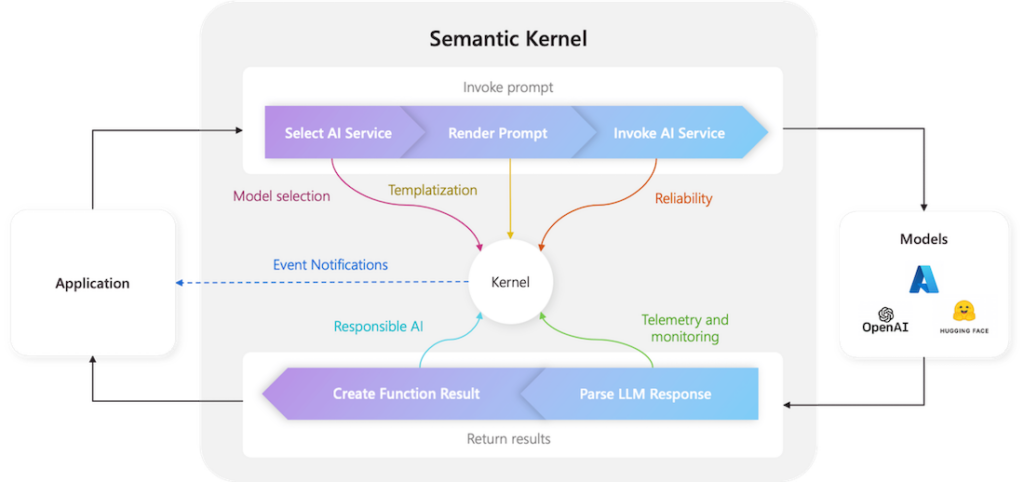
Source: Semantic Kernel Documentation
Key Features
- Production-ready SDK: Integrates large language models (LLMs) and data stores into applications, enabling the creation of product-scale GenAI solutions
- Multi-language support: Supports multiple programming languages: C#, Python, and Java
- Agent and Process Frameworks: Has Agent and Process Frameworks in preview, enabling customers to build single-agent and multi-agent solutions
- Semantic Kernel Agent Framework: Provides a platform within the Semantic Kernel ecosystem that allows for the creation of AI agents and the ability to incorporate agentic patterns into any application
- Semantic Kernel Process Framework: Provides an approach to optimize AI integration with your business processes
- Enterprise integration: Strong integration capabilities with existing enterprise systems
- Stable and reliable: Designed for production environments with enterprise-level support
Suitable for (Pros)
- If you need to build a reliable AI agent for a production environment with strong enterprise-level support and integration with existing systems
- When SDKs are needed in multiple languages as Semantic Kernel supports Python, C#, .NET, and Java
- Developer training support with enterprise support is available, particularly in the Microsoft Azure environment
- Production-ready applications: Ideal for stable, enterprise-ready applications
- Strong integration requirements: Excellent for applications requiring deep integration with existing enterprise systems
Where other frameworks flare better (Cons)
- Semantic Kernel falls into the category of SDK whereas the competitive frameworks provide higher-level abstractions and user interfaces for simpler agents
- Agent framework is still evolving (Agents are currently not available for Java)
- When vendor dependency on Microsoft needs to be avoided, other options can be considered as per the context
- Lower-level abstraction: May require more development effort compared to higher-level frameworks
Resources
- Official Documentation: Microsoft Learn - Semantic Kernel
- Training Course: Develop AI agents with Azure OpenAI and Semantic Kernel SDK
- GitHub Repository: Microsoft Semantic Kernel