AWS AgentCore
Overview
Launched in July 2025, Amazon Bedrock AgentCore enables you to deploy and operate Enterprise AI agents securely, at scale. It provides a comprehensive agentic platform for building, deploying, and operating highly effective agents using any framework and foundation model.
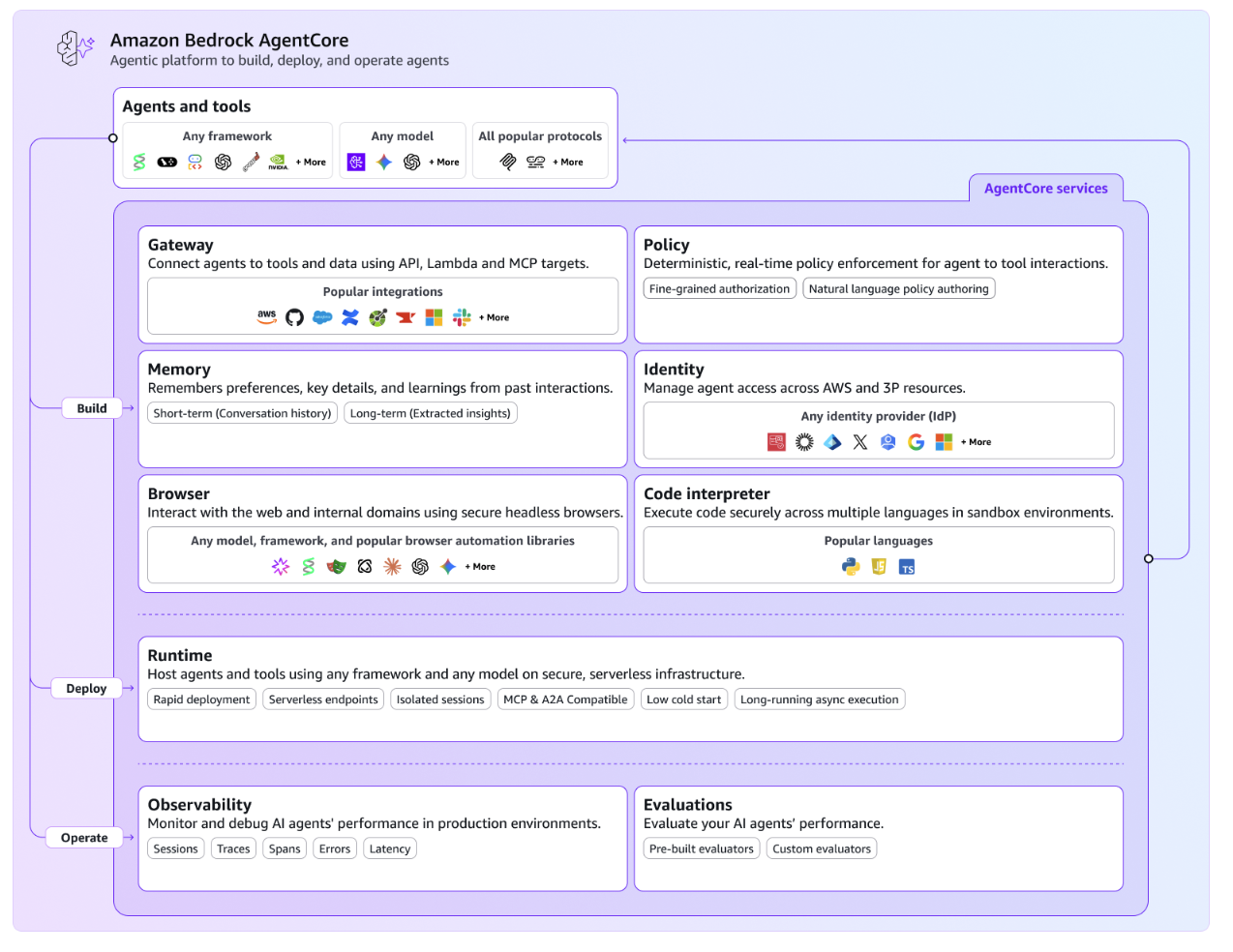
Source: AWS Bedrock AgentCore Documentation
The 13 Agentic AI Capability Domains (AWS Framework)
AWS organizes the full production-ready agentic stack into 13 capability domains, each mapped to specific AWS services:
| Domain | Description | Key AWS Services |
|---|---|---|
| Agent Reasoning | Structuring the think-act-observe loop so agents decompose goals, plan steps, and act reliably | Amazon Bedrock, Amazon SageMaker AI |
| Data & Retrieval | Ingestion, transformation, and lineage pipelines feeding agents accurate enterprise knowledge through dense, sparse, hybrid, and graph-based RAG | Amazon Bedrock Knowledge Bases, Amazon OpenSearch |
| Evaluation & Experimentation | Measuring agent accuracy, faithfulness, and task completion through test suites and online metrics | Amazon Bedrock AgentCore (Evaluations), Amazon CloudWatch |
| Deployment Lifecycle | Agent versioning, prompt promotion, rollback, and evaluation-gated CI/CD | AWS CodePipeline, Amazon SageMaker AI, AWS CDK |
| Agent Routing | Classifying inputs and dispatching to the right agent, model, or workflow path based on intent, cost, and capability | Amazon EventBridge, Amazon Bedrock |
| Observability | Distributed tracing, cost tracking, latency profiling, and anomaly detection | Amazon CloudWatch, AWS X-Ray, AWS Distro for OpenTelemetry |
| Tools & Integration | Connecting agents to external systems, APIs, live data, and specialized capabilities through tools, MCP servers, and A2A protocols | AWS Lambda, Amazon API Gateway, Amazon Bedrock AgentCore (Gateway) |
| Security Hardening | Securing compute, networking, containers, and dependencies against prompt injection, secrets exposure, and AI-specific attack vectors | Amazon GuardDuty, AWS Security Hub, Amazon Inspector |
| Orchestration | Coordinating networks of specialized agents through a control plane that sequences work, manages shared context, supports HITL approval, and handles failures | AWS Step Functions, Amazon Bedrock Multi-Agent Collaboration |
| Memory | Designing short-term, long-term, and episodic memory so agents maintain continuity, share context, and learn across sessions and agent boundaries | Amazon Bedrock AgentCore (Memory), Amazon DynamoDB, Amazon ElastiCache |
| Scaling & Cost Governance | Optimizing inference capacity, latency, and GPU utilization while managing token budgets, model tiering, caching, and spend attribution | Amazon EKS, AWS Fargate, Amazon Bedrock AgentCore (Runtime) |
| Guardrails & Safety | Enforcing input/output validation, content filtering, hallucination detection, and policy compliance | Amazon Bedrock Guardrails, Amazon Bedrock AgentCore (Policy) |
| Secure Identity | Engineering agent identity distinct from user identity, with least-privilege access, credential vaulting, and full audit trails | Amazon Cognito, AWS Secrets Manager, Amazon Bedrock AgentCore (Identity) |
AWS Marketplace provides 2,800+ agentic AI tools and capabilities mapped to these 13 domains.
Key Components
Core Services
- AgentCore Runtime: Scalable execution environment for agents
- Memory Management: Persistent and session-based memory systems — short-term session memory (events per session, up to 365-day retention, KMS encryption) and long-term persistent knowledge extracted via the Extraction → Consolidation → Reflection pipeline. Three extraction strategy tiers: Built-in (zero config), Built-in with overrides (custom prompts), and Custom self-managed (external DB integration). Retrieval via
RetrieveMemoryRecordssemantic search with metadata filters. - Observability: Comprehensive monitoring and logging capabilities
- Identity & Access Management: Fine-grained security and permissions
- Gateway: API gateway for agent interactions
- Browser Tool: Web-based agent interactions and browser automation
- Code Interpreter: Secure code execution environment
AgentCore has 6 different capabilities (see FAQ) as Runtime, Memory, Gateway, Browser Tool, Code Interpreter, Identity, and Observability.
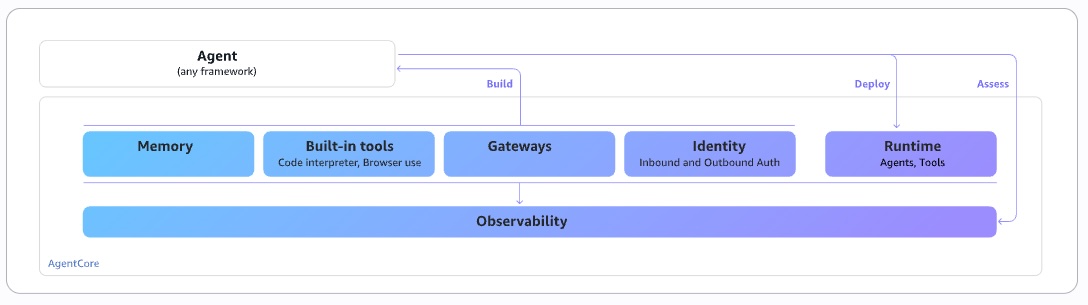
Architecture Overview
Source: AWS Bedrock AgentCore Documentation
Amazon Bedrock AgentCore is an agentic platform for building, deploying, and operating highly effective agents securely at scale using any framework and foundation model. With AgentCore, you can:
- Enable agents to take actions across tools and data with the right permissions and governance
- Run agents securely at scale
- Monitor agent performance and quality in production
- Operate without any infrastructure management
Framework Compatibility
AgentCore services work together or independently with any open-source framework:
Supported Frameworks
- CrewAI: Multi-agent collaboration framework
- LangGraph: Graph-based agent workflows
- LlamaIndex: Data-focused agent development
- Strands Agents: AWS native agent framework
- Custom Frameworks: Support for any framework via standard APIs
Model Flexibility
- Any Foundation Model: Not limited to AWS models
- Multi-provider Support: OpenAI, Anthropic, Google, and others
- Custom Models: Support for fine-tuned and custom models
- Model Routing: Intelligent routing based on task requirements
Key Features
Enterprise Security
- IAM Integration: Native AWS Identity and Access Management
- VPC Support: Deploy agents within your virtual private cloud
- Encryption: End-to-end encryption for data and communications
- Audit Logging: Comprehensive audit trails for compliance
- Policy Enforcement: Fine-grained policy controls
Scalability and Performance
- Auto-scaling: Automatic scaling based on demand
- Multi-region: Deploy agents across multiple AWS regions
- High Availability: Built-in redundancy and failover
- Performance Optimization: Optimized for low-latency interactions
Developer Experience
- Framework Agnostic: Use any development framework
- API-first Design: RESTful APIs for all operations
- SDK Support: SDKs for popular programming languages
- Local Development: Tools for local agent development and testing
Use Cases
Enterprise Applications
- Customer Service Automation: Scalable customer support agents
- Process Automation: Streamline business processes with intelligent agents
- Data Analysis: Automated data processing and insights generation
- Compliance Monitoring: Agents for regulatory compliance and monitoring
Technical Scenarios
- Multi-agent Systems: Coordinate multiple specialized agents
- Integration Projects: Connect agents with existing AWS services
- Batch Processing: Large-scale automated processing tasks
- Real-time Decision Making: Low-latency agent responses
Getting Started
Prerequisites
- AWS Account with appropriate permissions
- Bedrock service access in your region
- Understanding of your chosen agent framework
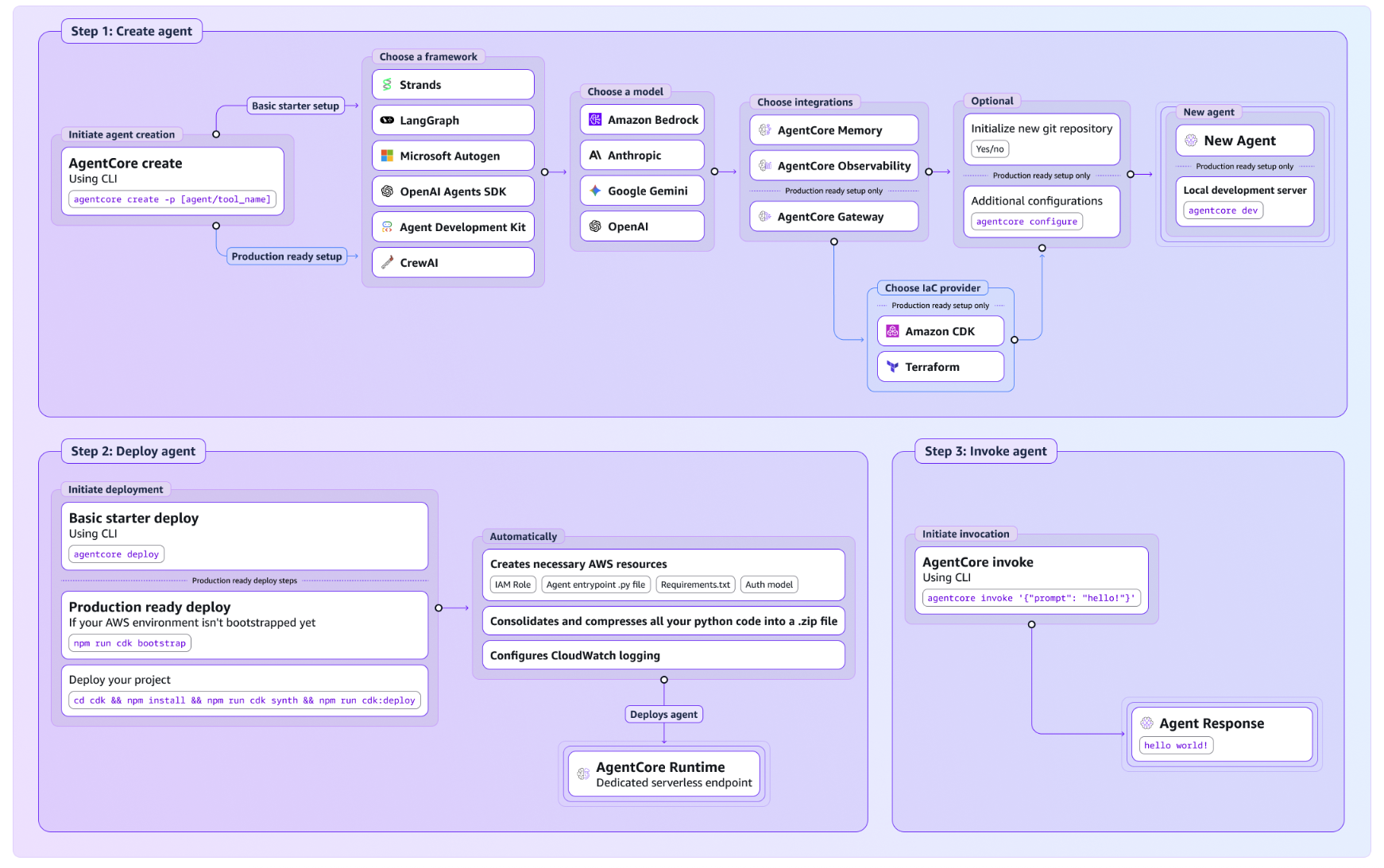
Setup Process
- Enable Bedrock AgentCore in your AWS account
- Configure IAM Roles for agent permissions
- Set up Agent Runtime environment
- Deploy Your Agent using your preferred framework
- Configure Monitoring and observability
Best Practices
- Security First: Implement least-privilege access patterns
- Monitor Everything: Set up comprehensive monitoring from the start
- Test at Scale: Use AWS testing tools for load and performance testing
- Cost Optimization: Implement cost monitoring and optimization strategies
- Framework Selection: Choose frameworks based on your specific use case
Integration with AWS Services
Native Integrations
- Amazon Bedrock: Foundation model access and management
- AWS Lambda: Serverless function integration
- Amazon S3: Data storage and retrieval
- Amazon DynamoDB: Fast, scalable database for agent state
- Amazon CloudWatch: Monitoring and logging
- AWS Step Functions: Workflow orchestration
Security Services
- AWS IAM: Identity and access management
- AWS KMS: Key management for encryption
- AWS CloudTrail: Audit logging and compliance
- Amazon VPC: Network isolation and security
Pricing Model
Cost Components
- Runtime Costs: Based on agent execution time and resources
- Model Usage: Foundation model API calls and token usage
- Storage Costs: Agent memory and data storage
- Data Transfer: Network costs for agent communications
- Additional Services: Costs for integrated AWS services
Cost Optimization
- Right-sizing: Choose appropriate instance types for your workload
- Reserved Capacity: Use reserved instances for predictable workloads
- Monitoring: Implement cost monitoring and alerting
- Efficient Frameworks: Choose frameworks optimized for your use case
Documentation and Resources
- Official Documentation: AWS Bedrock AgentCore
- Getting Started: AgentCore Developer Guide
- API Reference: AgentCore API Documentation
- Best Practices: AWS Agent Development Best Practices
- Blog Announcement: Introducing Amazon Bedrock AgentCore
- AWS Builder Center: Agentic AI Design Patterns - A framework with six key components: Perception, Cognitive, Action, Learning, Collaboration, and Security
Related Sections
- Section 4.4: AWS Strands Agents Framework
- Section 11.3: AWS Security Perspective
- Section 14.2: AWS Maturity Model for Generative AI
- Section 15.1: AWS AI Agents Marketplace
See Also
- Multi-Agent Systems — Four planes, orchestration patterns, non-determinism math
- AWS Strands Agents
- ProductionBestPractices/deployment.md
- ProductionBestPractices/security.md
- ProductionBestPractices/observability.md
- Standards/agent2agent.md
- Standards/mcp.md
- AgentOps — AWS Perspective: Four-Pillar AgentOps Framework
References
- AWS Marketplace — Building Agentic Systems: Multi-Agent Architectures (Module 4) — Workshop covering the 13-domain capability stack, four planes of multi-agent systems, and AWS service mappings
- AWS Marketplace — Building Agentic Systems: Agent Memory Systems (Module 7) — AgentCore Memory short-term/long-term architecture, extraction strategy tiers, partner memory stack (Redis Cloud, MongoDB Atlas, Neo4j AuraDB), memory governance
- AWS Bedrock AgentCore Documentation
- AgentOps: Operationalize agentic AI at scale with Amazon Bedrock AgentCore (AWS Machine Learning Blog)