LlamaIndex
Overview
LlamaIndex is a data framework for connecting custom data sources to large language models. LlamaIndex started with data framework capabilities for LLM applications and has evolved to cover AI agents, document parsing & indexing, workflow, connectors-based integration, modularity & extensibility, and many more capabilities.
High-level Architecture
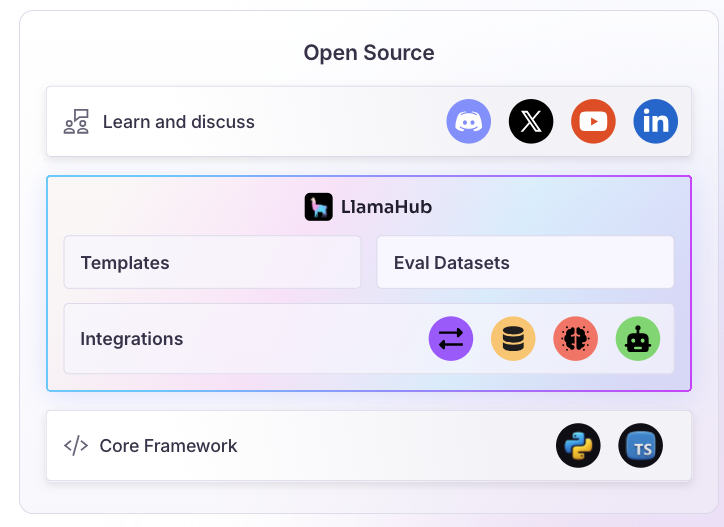
Source: LlamaIndex Framework
Key Features
- Data framework capabilities: Started with data framework capabilities for LLM applications and has evolved to cover AI agents, document parsing & indexing, workflow, connectors-based integration, modularity & extensibility
- LlamaCloud: Offers a SaaS capability as LlamaCloud as a knowledge management hub for AI Agents
- LlamaParse: A differentiated offering for transforming instructed data into LLM-optimized formats
- LlamaHub: A centralized place to explore Agents, LLMs, Vector Stores, Data Loaders, etc.
- Document processing: Efficient parsing and indexing of complex documents
- Knowledge management: Comprehensive knowledge management capabilities for AI systems
- Multi-modal support: Supports various data types and formats
Suitable for (Pros)
- As an alternative to LangChain: LlamaIndex has evolved as a compelling alternative, particularly for data-intensive LLM applications
- The ability to parse and index complex documents efficiently with LlamaCloud makes it a compelling option for enterprises seeking quicker time-to-market
- Building knowledge-intensive AI systems like chatbots and question-answering systems
- Data-centric applications: Excellent for applications that require sophisticated data processing and retrieval
- Enterprise knowledge management: Strong capabilities for enterprise-scale knowledge management systems
Where other frameworks flare better (Cons)
- Primarily focused on data indexing and retrieval, with less emphasis on complex agent behaviors and decision-making. However, the evolution of the framework towards building Agentic apps provides promising capabilities
- Limited agent orchestration: Less sophisticated agent coordination compared to specialized multi-agent frameworks
- Learning curve: Requires understanding of data indexing and retrieval concepts
Resources
- Official Website: LlamaIndex
- LlamaCloud: Knowledge management hub
- LlamaParse: Document parsing service
- LlamaHub: Centralized resource hub
- GitHub Repository: LlamaIndex GitHub
See Also
- Agent Development Frameworks
- RAG Reference Architecture
- Context Engineering
- Memory Solutions & Technology Radar — LlamaIndex Memory module vs. dedicated memory vendors