Google ADK (Agent Development Kit)
Overview
Agent Development Kit (ADK) is a flexible and modular framework for developing and deploying AI agents. While optimized for Gemini and the Google ecosystem, ADK is model-agnostic, deployment-agnostic, and is built for compatibility with other frameworks. ADK was designed to make agent development feel more like software development, to make it easier for developers to create, deploy, and orchestrate agentic architectures that range from simple tasks to complex workflows.
High-level Architecture
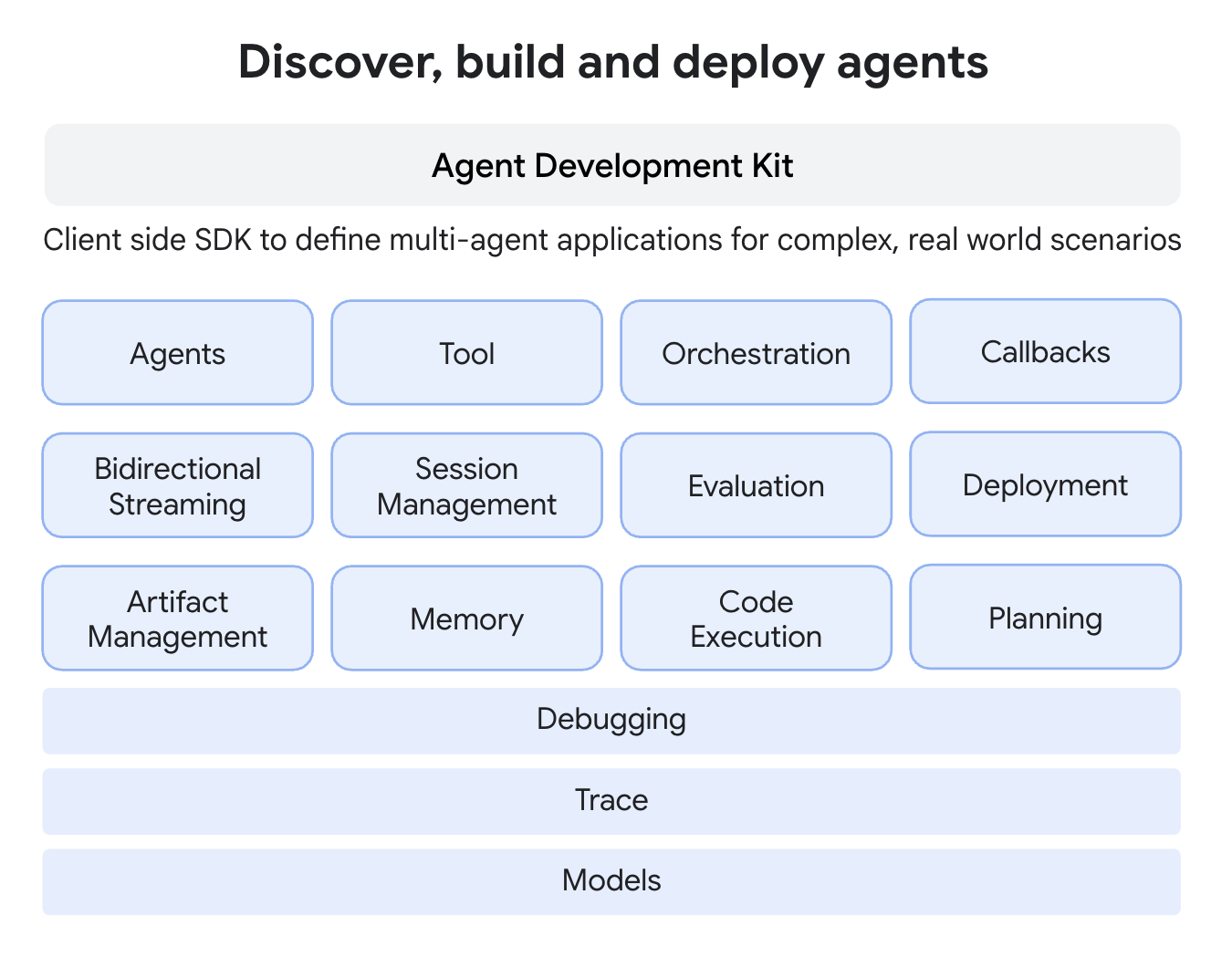
Source: Google ADK Documentation
Key Features
- Native framework: Building and orchestrating agentic workflows on Google Cloud
- Tight integration: With Vertex AI and Gemini models
- Built-in support: For multi-agent coordination and task decomposition
- First-class tool invocation: And function calling capabilities
- Enterprise-grade security: Policy enforcement, and IAM integration
- Observability hooks: Aligned with Google Cloud logging and monitoring
- Managed deployment: And scaling using GCP infrastructure
- Multi-language support: Supports Golang, Java, Python, TypeScript
Suitable for (Pros)
- Multi-language framework: When you are looking for a framework across multiple languages as ADK supports Golang, Java, Python, TypeScript
- Organizations standardized on Google Cloud and Vertex AI
- Enterprise use cases requiring governed and secure agent deployments
- Large-scale, production-grade multi-agent systems
- Regulated industries needing strong compliance and auditability
- Teams prioritizing managed services over custom infrastructure
- Scenarios benefiting from tight coupling with Gemini model capabilities
Where other frameworks flare better (Cons)
- Limited flexibility for multi-cloud or on-prem deployments
- Strong dependency on Google Cloud services and ecosystem
- Less suitable for rapid experimentation or research-heavy workflows
- Reduced control over low-level agent state compared to graph-based frameworks
- Smaller open-source ecosystem compared to LangGraph, CrewAI, or AutoGen
- Slower iteration for teams seeking lightweight, model-agnostic frameworks