Agentic Architecture Components Selection
Overview
Selecting the right architectural components is crucial for building effective agentic AI systems. This Guide by Google provides a framework for choosing components based on your specific requirements and constraints.
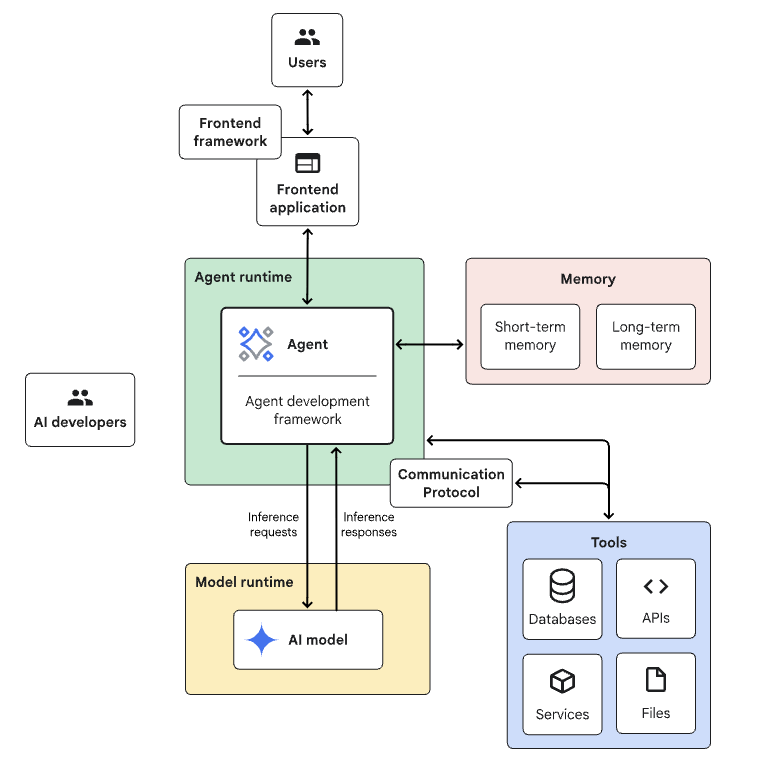
Core Components
1. Language Model Layer
Purpose: Provides reasoning and language understanding capabilities
Options: - Large Language Models (LLMs) - OpenAI GPT-4/GPT-3.5 - Anthropic Claude - Google Gemini - Open source alternatives (Llama, Mistral)
Selection Criteria: - Task complexity requirements - Latency constraints - Cost considerations - Privacy and security requirements
2. Agent Framework
Purpose: Orchestrates agent behavior and tool interactions
Options: - LangChain: Comprehensive ecosystem with extensive integrations - LangGraph: Graph-based workflow orchestration - AutoGen: Multi-agent conversation systems - CrewAI: Role-based agent collaboration - Semantic Kernel: Microsoft's AI orchestration platform
Selection Criteria: - Programming language preference - Integration requirements - Scalability needs - Community support
3. Memory System
Purpose: Stores and retrieves context, experiences, and knowledge
Components: - Short-term Memory: Conversation context, working memory - Long-term Memory: Persistent knowledge, learned experiences - Vector Databases: Semantic search and retrieval
Options: - Vector Stores: Pinecone, Weaviate, Chroma, FAISS - Traditional Databases: PostgreSQL, MongoDB - Specialized Solutions: Mem0, Zep
4. Tool Integration Layer
Purpose: Enables agents to interact with external systems and APIs
Components: - API Connectors: REST, GraphQL, gRPC interfaces - Function Calling: Structured tool invocation - Plugin Systems: Extensible tool ecosystems
Standards: - Model Context Protocol (MCP): Standardized tool integration - OpenAPI Specifications: API documentation and discovery - Function Schemas: Tool capability descriptions
5. Orchestration Engine
Purpose: Manages agent workflows and decision-making processes
Patterns: - Sequential Processing: Linear task execution - Parallel Processing: Concurrent task handling - Graph-based Workflows: Complex dependency management - Event-driven Architecture: Reactive system design
Architecture Patterns
Single-Agent Architecture
User Input → Agent → LLM → Tools → Response
Use Cases: - Simple task automation - Content generation - Question answering
Multi-Agent Architecture
User Input → Orchestrator → Agent Pool → Coordination → Response
Use Cases: - Complex problem solving - Specialized task distribution - Collaborative workflows
Hierarchical Architecture
User Input → Manager Agent → Specialist Agents → Task Execution
Use Cases: - Enterprise workflows - Structured problem decomposition - Role-based task assignment
Selection Framework
1. Requirements Analysis
- Functional Requirements: What tasks must the system perform?
- Non-functional Requirements: Performance, scalability, security
- Integration Requirements: Existing systems and APIs
- Resource Constraints: Budget, infrastructure, expertise
2. Component Evaluation Matrix
| Component | Criteria | Weight | Options | Score |
|---|---|---|---|---|
| LLM | Performance | High | GPT-4, Claude, Gemini | - |
| Framework | Ecosystem | Medium | LangChain, AutoGen | - |
| Memory | Scalability | High | Vector DB, Traditional | - |
| Tools | Integration | Medium | MCP, Custom APIs | - |
3. Architecture Decision Records (ADRs)
Document key architectural decisions including: - Context and requirements - Considered options - Decision rationale - Consequences and trade-offs
Best Practices
Component Integration
- Loose Coupling: Minimize dependencies between components
- Standard Interfaces: Use established protocols and APIs
- Error Handling: Implement robust failure recovery
- Monitoring: Track component performance and health
Scalability Considerations
- Horizontal Scaling: Design for distributed deployment
- Caching Strategies: Optimize for performance
- Load Balancing: Distribute workload effectively
- Resource Management: Monitor and optimize resource usage
Security and Privacy
- Data Protection: Encrypt sensitive information
- Access Control: Implement proper authentication/authorization
- Audit Logging: Track system access and changes
- Compliance: Meet regulatory requirements
Agent Anatomy — Internal Building Blocks
Arsanjani & Bustos (2026) define seven internal components that form the continuous operational loop of any AI agent. These serve as the architectural building blocks behind every component selection decision:
| Component | Function | Architectural Role | Implementation |
|---|---|---|---|
| Goals | Objectives the agent seeks to achieve | Defines the agent's objective function; drives high-level planning | Configuration parameters or dynamic state |
| Sense (Perception) | Gathers data from environment (APIs, databases, sensors) | Input layer | API listeners, stream processors, MCP clients |
| Reason (Cognition) | Analyzes sensed information | Cognitive core — where the agent-ready LLM is integrated | LLM call with goals + context |
| Plan | Devises a sequence of actions | Tactical layer; breaks strategy into executable steps | LLM-generated task sequence |
| Act (Action) | Executes plan via tools | Output layer | External API calls, code execution, response generation |
| Memory | Stores knowledge, state, and past experience | State management | Short-term (in-context); long-term (vector databases, key-value stores) |
| Coordinate | Interacts with other agents (multi-agent systems only) | Inter-agent communication | A2A protocol; task lifecycle states (submitted → working → completed) |
The agentic loop: Sense → Reason → Plan → Act → (feedback) → Sense. Each iteration allows the agent to learn from outcomes.
Hierarchy of autonomy — distinguishing LLMs, automated workflows, and true agents:
| Level | Type | Characteristics |
|---|---|---|
| 1 | LLM / Model | Stateless, probabilistic, passive — responds to prompts only |
| 2 | Automated Workflow | Deterministic, rigid, scripted — if-this-then-that logic |
| 3 | AI Agent | Goal-oriented, stateful, adaptive — sense-reason-act-reflect loop |
Technical considerations by component:
| Technical Concern | Component(s) Affected |
|---|---|
| Data processing and integration | Sense, Memory |
| Knowledge representation | Reason, Memory |
| LLM integration and orchestration | Reason, Plan, Coordinate |
| Reliable tool use mechanisms | Act |
| State management and memory | Memory |
| Scalability of agent populations | Coordinate, overall architecture |
| Inter-agent communication efficiency | Coordinate |
| Security and governance | Reason (prompt injection), Act (sandboxing), Memory (privacy), Coordinate (AuthN/AuthZ) |
Complementary Framing: Confluent's Nine-Component Anatomy
Confluent's A Guide to Event-Driven Design for Agents and Multi-Agent Systems (2025) describes agent anatomy with nine components rather than seven. Most map directly onto the Arsanjani & Bustos table above (Perception↔Sense, Reasoning↔Reason, Planning↔Plan, Action↔Act, Coordination↔Coordinate), but it breaks out two components the Arsanjani table folds elsewhere:
| Component | Function | Relation to Arsanjani Table |
|---|---|---|
| Persona (Job Function) | The agent's job description embedded in the system prompt, shaping behavior by influencing the model's token probability distribution | Not modeled separately above — sits upstream of Goals, configuring how Reason is invoked |
| Learning | Refining reasoning via dynamic in-context adjustment or reinforcement learning (rewards/penalties), distinct from simply storing state | Not modeled separately above — treated as a capability of Reason/Memory together rather than its own component |
| Tool Interface | Modular API handlers / plugin architecture extending the agent's reach into specialized capabilities | Corresponds to the implementation layer underneath Act |
Treat Persona and explicit Tool Interface as useful additions when designing system prompts and plugin architectures; treat Learning as a reminder that context-adaptation and RL-based refinement are architecturally distinct from static Memory storage.
See Also
- Multi-Agent Systems
- 12-Factor Agents
- Agent Development Frameworks
- Agent Technology Stack
- Agentic Architectural Patterns — Arsanjani & Bustos
- Event-Driven Design Patterns for Multi-Agent Systems (Confluent)
- Arsanjani GenAI Maturity Model
References
- Arsanjani, A., & Bustos, J.P. (2026). Agentic Architectural Patterns for Building Multi-Agent Systems. Packt Publishing. ISBN 978-1-80602-957-0. — Source for agent anatomy table and hierarchy of autonomy.
- Falconer, S. (2025). A Guide to Event-Driven Design for Agents and Multi-Agent Systems. Confluent, Inc. — Source for the nine-component agent anatomy framing.