Gartner's Perspective on Agentic AI Maturity
Overview
Gartner provides strategic insights into the maturity and evolution of agentic AI systems from an enterprise perspective. Their research focuses on organizational readiness, implementation strategies, and the progression of AI agent capabilities within business contexts.
Key Insights
Gartner's perspective on agentic AI maturity encompasses several critical dimensions:
- Organizational Readiness: Assessment of enterprise capabilities to adopt and scale agentic AI solutions
- Technology Integration: Evaluation of how AI agents integrate with existing enterprise systems and workflows
- Governance and Risk Management: Framework for managing risks associated with autonomous AI systems
- Business Value Realization: Metrics and approaches for measuring ROI from agentic AI investments
Maturity Assessment Framework
Gartner's approach to agentic AI maturity typically includes:
- Initial/Ad Hoc: Basic experimentation with AI agents in isolated use cases
- Developing: Structured pilot programs with defined governance
- Defined: Established processes and standards for agent development and deployment
- Managed: Comprehensive monitoring and optimization of agent performance
- Optimizing: Continuous improvement and innovation in agentic capabilities
Strategic Recommendations
Based on Gartner's research, organizations should focus on:
- Building foundational AI governance frameworks before scaling agent deployments
- Investing in change management and workforce development for human-agent collaboration
- Establishing clear metrics for agent performance and business impact
- Developing robust security and compliance frameworks for autonomous systems
Cross-References
- Section 3: Architecture & Design Patterns - Gartner LLM-based AI Design Patterns
- Section 11: Agentic AI Security - Risk management frameworks
- Section 16: AI Agents Best Practices - Enterprise implementation guidance
Resources
- Gartner: Emerging Patterns for Building LLM-Based AI Agents
- Gartner Magic Quadrant reports on AI platforms and services
- Gartner Hype Cycle for Artificial Intelligence
 Source: AI Maturity and Roadmap: Accelerate Your Journey to AI Excellence
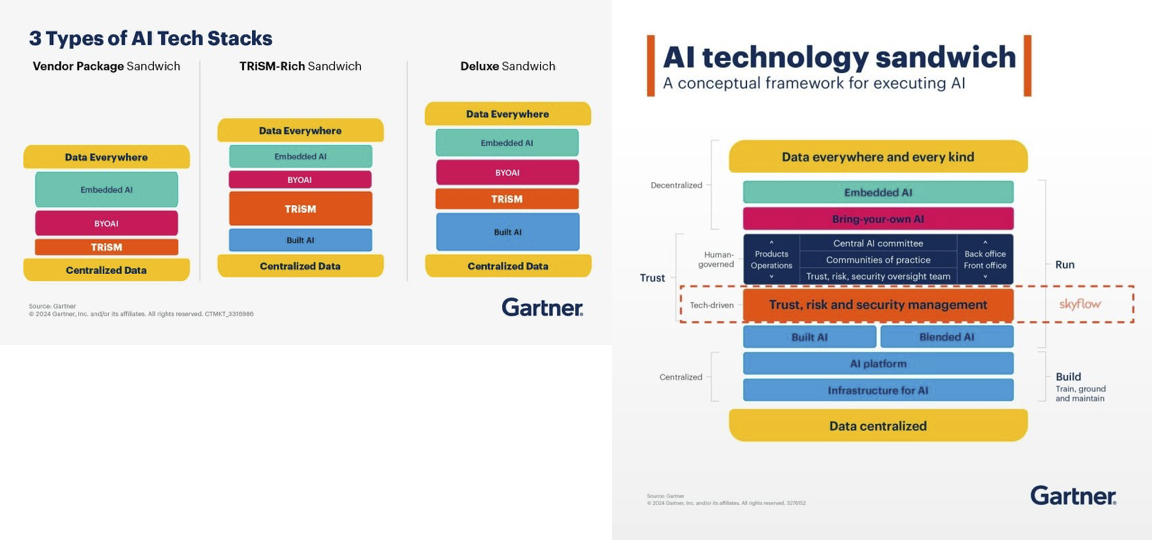 Ref: https://www.gartner.com/en/articles/ai-tech-stack