Multi-Agent Systems
Overview
Multi-agent systems (MAS) consist of multiple autonomous agents that interact and collaborate to solve complex problems that are beyond the capabilities of individual agents.
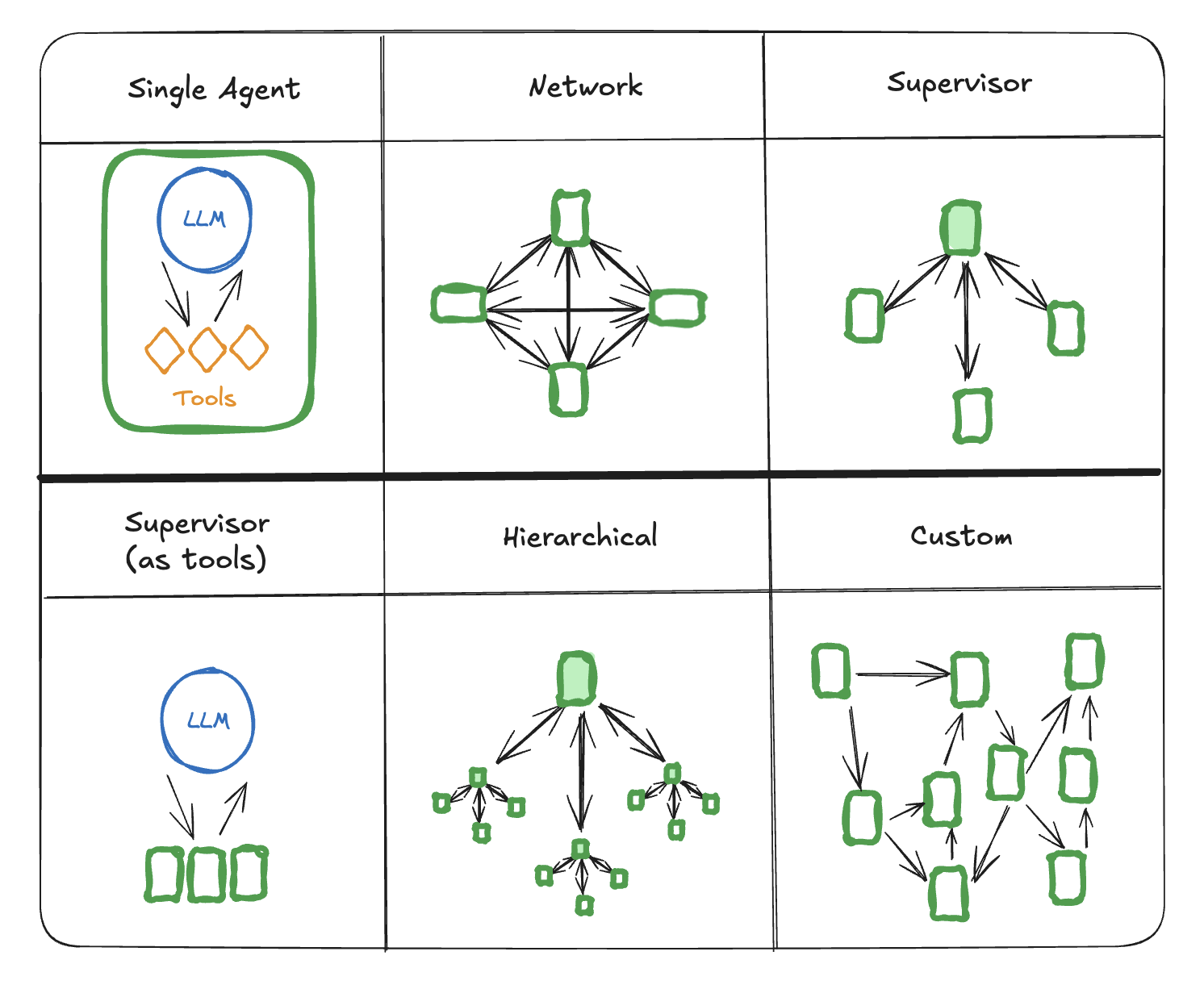 (Source: LangChain)
Key Characteristics
Distributed Intelligence
- Decentralized Decision Making: Each agent makes autonomous decisions
- Specialized Capabilities: Agents have specific roles and expertise
- Collaborative Problem Solving: Agents work together toward common goals
- Emergent Behavior: System-level intelligence emerges from agent interactions
Communication and Coordination
- Message Passing: Agents exchange information and requests
- Negotiation Protocols: Agents negotiate resource allocation and task assignment
- Consensus Mechanisms: Agents reach agreement on shared decisions
- Coordination Strategies: Agents synchronize their actions
Architecture Patterns
Hierarchical Organization
Manager Agent
├── Specialist Agent A
├── Specialist Agent B
└── Coordinator Agent
    ├── Worker Agent 1
    └── Worker Agent 2
Benefits: - Clear command structure - Efficient task delegation - Scalable organization
Peer-to-Peer Network
Agent A ←→ Agent B
    ↕       ↕
Agent C ←→ Agent D
Benefits: - Fault tolerance - Distributed processing - No single point of failure
Blackboard Architecture
Shared Knowledge Space (Blackboard)
    ↑           ↑           ↑
Agent A    Agent B    Agent C
Benefits: - Shared information access - Asynchronous collaboration - Flexible agent participation
Implementation Frameworks
AutoGen (Microsoft)
- Conversational Agents: Multi-agent chat systems
- Role-based Design: Specialized agent roles
- Human-in-the-loop: Interactive agent collaboration
import autogen

# Define agents with specific roles
user_proxy = autogen.UserProxyAgent("user_proxy")
assistant = autogen.AssistantAgent("assistant")
critic = autogen.AssistantAgent("critic")

# Create group chat
groupchat = autogen.GroupChat(
    agents=[user_proxy, assistant, critic],
    messages=[],
    max_round=10
)
CrewAI
- Role-based Agents: Defined roles and responsibilities
- Task Management: Structured task assignment and execution
- Process Orchestration: Workflow management
from crewai import Agent, Task, Crew

# Define specialized agents
researcher = Agent(
    role='Researcher',
    goal='Gather comprehensive information',
    backstory='Expert in information gathering'
)

writer = Agent(
    role='Writer',
    goal='Create engaging content',
    backstory='Skilled content creator'
)

# Create crew with agents and tasks
crew = Crew(
    agents=[researcher, writer],
    tasks=[research_task, writing_task]
)
LangGraph
- Graph-based Workflows: Visual workflow representation
- State Management: Shared state across agents
- Conditional Logic: Dynamic workflow paths
Communication Protocols
Message Types
- Inform: Share information without expecting response
- Request: Ask for action or information
- Propose: Suggest a course of action
- Accept/Reject: Respond to proposals
- Query: Ask questions about agent state or capabilities
Coordination Mechanisms
- Contract Net Protocol: Bidding for task assignment
- Consensus Algorithms: Distributed agreement
- Market Mechanisms: Economic-based coordination
- Voting Systems: Democratic decision making
Use Cases and Applications
Software Development
- Code Review Teams: Multiple agents reviewing different aspects
- Testing Automation: Specialized testing agents
- Documentation Generation: Collaborative content creation
Business Process Automation
- Customer Service: Routing and specialized handling
- Supply Chain Management: Distributed optimization
- Financial Analysis: Multi-perspective evaluation
Research and Analysis
- Literature Review: Parallel information gathering
- Data Analysis: Specialized analytical agents
- Report Generation: Collaborative synthesis
Design Considerations
Agent Specialization
- Domain Expertise: Agents focused on specific areas
- Capability Complementarity: Agents with different strengths
- Role Clarity: Well-defined responsibilities and boundaries
Scalability
- Dynamic Agent Creation: Adding agents as needed
- Load Distribution: Balancing work across agents
- Resource Management: Efficient resource utilization
Fault Tolerance
- Redundancy: Multiple agents for critical functions
- Graceful Degradation: System continues with reduced capability
- Recovery Mechanisms: Automatic error recovery
Best Practices
System Design
- Clear Role Definition: Each agent should have well-defined responsibilities
- Minimal Coupling: Reduce dependencies between agents
- Standard Interfaces: Use consistent communication protocols
- Monitoring and Logging: Track agent interactions and performance
Implementation
- Start Simple: Begin with basic multi-agent interactions
- Iterative Development: Gradually add complexity and agents
- Testing Strategy: Test individual agents and system interactions
- Performance Optimization: Monitor and optimize system performance
Challenges and Solutions
Common Challenges
- Coordination Overhead: Managing agent interactions
- Conflict Resolution: Handling disagreements between agents
- Scalability Limits: Performance degradation with many agents
- Debugging Complexity: Tracing issues in distributed systems
Solutions
- Efficient Protocols: Use lightweight communication mechanisms
- Conflict Resolution Strategies: Implement negotiation and arbitration
- Hierarchical Organization: Structure agents to reduce complexity
- Comprehensive Logging: Detailed tracking of agent activities
The Four Planes of a Multi-Agent System (AWS)
AWS frames multi-agent systems around four distinct planes, each with a clear responsibility:
| Plane | Responsibility | AWS Services |
|---|---|---|
| Control plane | Orchestrator decomposes tasks, delegates to subagents, monitors progress, synthesizes results. Directs — does not execute. | Amazon Bedrock Multi-Agent Collaboration (supervisor mode), AWS Step Functions |
| Execution plane | Independent specialized agents with scoped system prompts, curated tools, and purpose-built retrieval corpora. Independently deployable, evaluatable, and scalable. | Amazon Bedrock AgentCore, AWS Lambda |
| State plane | Shared information layer: task state (durable), session context (low latency), domain knowledge (retrieval). Agents coordinate through state, not direct coupling. | Amazon DynamoDB, Amazon ElastiCache, Amazon Bedrock Knowledge Bases |
| Capability plane | Tools exposed through MCP servers — standardized, discoverable, governed. Shared across agents with per-agent access controls at the server level. | Amazon MCP Servers, Amazon Bedrock AgentCore, AWS Lambda |
When to Move to Multi-Agent
Four triggers that signal a single-agent workflow is breaking down:
| Trigger | Description |
|---|---|
| Context saturation | Complex long-horizon tasks overflow a single context window. The agent forgets earlier work but does not know it has. |
| Task specialization | One agent trying to excel at multiple domains simultaneously produces mediocrity across the board rather than excellence in any domain. |
| Latency and parallelism | Sequential execution is unnecessarily slow. Independent subtasks should run in parallel. |
| Fault isolation | A single-agent failure derails the entire workflow. Multi-agent systems localize failures — one agent down does not stop the rest. |
Rule of thumb: move to multi-agent when your single-agent workflow shows any two of these four triggers simultaneously.
Orchestration Patterns
Four patterns, each suited to a different task structure:
| Pattern | When to Use | AWS Implementation | Watch Out |
|---|---|---|---|
| Centralized orchestration | Complex, open-ended tasks requiring dynamic planning and real-time adaptation | Amazon Bedrock Multi-Agent (supervisor mode) | Orchestrator is a single point of failure — invest heavily here |
| Skill-based dispatch | Fixed set of well-defined, parameterized operations invoked by a reasoning agent | AWS Lambda functions behind MCP server interfaces | Less flexible for open-ended tasks; best for known, stable operations |
| Handoff chains | Linear sequential pipelines where each step depends on the previous output | Step Functions state machines with Choice states | Rigidity — branching logic can become unwieldy without proper Choice state design |
| Parallel fan-out and synthesis | Multi-domain tasks where independent specialist analysis can be parallelized | Amazon EventBridge + Amazon SQS + Lambda specialists | Synthesis step is routinely underbuilt — handle conflicting results explicitly |
Non-Determinism at Scale
Non-determinism compounds across agent boundaries. With 90% per-agent accuracy:
| Pipeline depth | Compound accuracy |
|---|---|
| 1 agent | 90% |
| 2-agent pipeline | 81% |
| 4-agent pipeline | 66% |
With 99% per-agent accuracy, a 4-agent pipeline reaches 96%. Individual agent quality must be substantially higher than the acceptable overall error rate.
Three defenses against propagation:
- Structured schema at every boundary — require JSON-schema-validated outputs at every handoff. Free-form inter-agent prose is a bug.
- Abstention as a feature — agents uncertain about a task should return a structured abstention response, not a low-confidence guess. Build and evaluate abstention behavior explicitly in golden datasets.
- End-to-end evaluation (non-optional) — per-agent evaluations are necessary but not sufficient. Run complete workflow evaluations. Builtin.GoalSuccessRate measures system-level success, not per-agent output quality.
Shared State and Handoff Design
What to store where:
| Store | Latency | Use For | AWS Service |
|---|---|---|---|
| Task state | Single-digit ms reads, survives agent failures, audit trail | Durable workflow execution state | Amazon DynamoDB |
| Session context | Sub-ms access, TTL-managed | Conversation turns + recently accessed payloads | Amazon ElastiCache |
| Domain knowledge | Vector retrieval, governance-controlled | Shared across all agents with no duplication | Amazon Bedrock Knowledge Bases |
| Intermediate results | Cost-effective, durable | Referenced by task state record in DynamoDB, not forwarded in payloads | Amazon S3 |
Handoff payload principle: include what the next agent needs — nothing more. Verbose payloads bloat context windows and degrade reasoning quality.
MCP vs. A2A in Multi-Agent Systems
| Protocol | Interface | Pattern | Rule |
|---|---|---|---|
| MCP | Agent → Tool | Client-server; agent is always the client, tool server is always the responder | Per-agent access controls must be implemented at the server level — not in system prompts |
| A2A | Agent → Agent | Peer protocol; any agent can initiate or receive | Do not use MCP for agent-to-agent delegation — it is the wrong abstraction |
A2A task objects carry: description, context, authorized resources, expected output schema, and constraints. Agent cards enable dynamic discoverability without pre-built integration.
Failure Modes Unique to Multi-Agent Systems
| Failure Mode | Description | Mitigation |
|---|---|---|
| Cascading failures | One failing agent takes down the entire chain | Circuit breakers in Step Functions catch repeated failures and route to fallback paths |
| Orchestration loops | Orchestrators that repeatedly delegate tasks in a cycle run up unbounded costs | Explicit step counters, loop detection, and forced termination conditions; Step Functions enforces maximum execution time and step limits natively |
| Conflicting parallel outputs | Parallel agents evaluate the same configuration and reach opposite conclusions | Synthesis step must resolve conflicts explicitly — not with a generic summarize prompt; in safety-critical domains, the conservative result always wins |
| Context corruption at handoffs | Malformed, truncated, or semantically inconsistent payloads cause silent failures | Schema-validate every incoming handoff payload before acting; return a structured error to the orchestrator on validation failure |
Security at Agent Boundaries
Zero trust: treat every agent boundary as a trust boundary. Apply security controls redundantly at MCP server, agent boundary, and orchestration layer.
| Risk | Mitigation |
|---|---|
| Overprivileged subagents | Least-privilege scoped credentials per task; AWS STS generates time-limited credentials |
| Prompt injection propagation | Content filtering at every agent boundary via Amazon Bedrock Guardrails; treat all externally-originated content as untrusted regardless of how many agents have processed it |
| Credential exposure in payloads | Never pass raw credentials in task objects; use IAM role-based delegation; AWS IAM Roles Anywhere for non-AWS workloads |
| Unauthorized agent discovery | Agent card registry with authentication requirements |
Distributed Observability
A consistent trace ID — propagated through every agent and tool call — is the only way to correlate logs into a single execution graph. Without distributed tracing, root-cause analysis is guesswork.
Layered evaluation strategy: per-agent (isolated datasets) + full workflow (Builtin.GoalSuccessRate) + differential analysis correlating per-agent scores against system-level outcomes.
Seven Benefits of Multi-Agent Systems
From Mastering Multi-Agent Systems (Galileo, 2026), the seven primary advantages over single-agent approaches:
| Benefit | Single-Agent Limitation | Multi-Agent Solution |
|---|---|---|
| Specialization | One model handles all tasks, losing context as it switches domains | Specialized agents each maintain focused context, reducing hallucinations |
| Validation (orthogonal checking) | No self-correction mechanism; confident when wrong | Peer-review layers: Generation → Logic → Fact → Safety agents catch errors the initial model misses |
| Parallel processing | Sequential processing hits time and context limits | Dispatcher + parallel Analysis agents + Aggregator; 20 min → 3 min on 100-review workloads |
| Fault tolerance | Single point of failure stops everything | Graceful degradation: failed agent spawns backup or flags for human review; partial work is preserved |
| Dynamic routing | Same model for simple FAQs and complex reasoning | Route by confidence: >0.9 = fully automated; 0.7–0.9 = human review option; <0.7 = specialist or human |
| Context preservation | Forgets early messages as context window fills | Separate Memory Agent + Consistency Checker maintains coherence across 50+ message sessions |
| Observability | Black box — hard to know why something went wrong | Per-agent metrics, A/B testing of individual agents, token cost attribution per component |
Gartner prediction: 40% of agentic AI projects will be canceled by 2027 due to reliability issues. The successful 60% will match architecture to actual needs.
When Multi-Agent Systems Actually Work
Three patterns that successful implementations share (from Galileo research):
- Problems that can be parallelized — subtasks require zero communication during processing. Each agent works independently; results are aggregated at the end.
- Read-heavy, write-light workloads — agents primarily consume information rather than modify shared state. Coordination complexity drops dramatically.
- Explicit coordination rules — deterministic orchestration with clear handoff points, defined data formats, interaction protocols, and fallback behaviors.
Checklist before building: - Can you break down the work into completely independent tasks? - Do agents primarily read and analyze rather than write and modify? - Can results be combined mechanically (concatenation, voting, averaging)? - Is parallel processing speed worth a 2–5× cost increase? - Can one agent failing be isolated from others?
When Multi-Agent Systems Fail
Coordination Cost Economics
Two agents need one communication channel. Three need three. Four need six. Coordination overhead grows quadratically. Three high-impact failure scenarios:
- Memory fragments across agents — Agent B needs Agent A's output but gets either too much (expensive) or too little (broken functionality). No clean way to share only relevant details.
- Operational costs multiply — A task costing $0.10 for a single agent may cost $1.00 in a multi-agent system due to context sharing, handoffs, and verification.
- Write conflicts cascade — Agent A creates a user profile structure. Agent B creates a different one. Agent C reconciles both and creates a third. Three incompatible representations of the same data.
Concrete Cost Comparison (Customer Support)
| Approach | Time | Cost | Failure Points |
|---|---|---|---|
| Single agent (reads ticket, searches docs, checks account, crafts reply) | 2s | $0.05 | 1 |
| Multi-agent (Triage + Research + Account + Response + Orchestrator) | 3.8s | $0.40 | 5 agents, 10 potential interaction bugs |
The multi-agent system costs 8× more, takes nearly twice as long, and creates exponentially more ways to fail.
The Model Evolution Challenge
Rich Sutton's Bitter Lesson: general methods using more computation ultimately win over specialized structures. Multi-agent complexity often compensates for current model limitations that will disappear:
- Context windows too small → distribute the load (but windows are growing)
- Tool calling unreliable → create dedicated tool-use agents (but models are improving)
- Complex reasoning fails in one pass → split into specialist agents (but newer models handle this natively)
Teams that built complex orchestration layers for GPT-4 found them unnecessary with GPT-5. Design for removal: write orchestration code in a separate module that can be deleted when a better model arrives. Make agent boundaries collapsible so Agent A (research) and Agent B (summarize) can merge into one "research and summarize" agent later.
The Decision Framework (5 Questions)
Before building a multi-agent system, answer in order:
- Can better prompt engineering solve this? In 80% of cases, a well-crafted single agent with good context management beats multi-agent.
- Are your subtasks genuinely independent? Real independence = zero shared state during processing. Sequential tasks with dependencies are not parallel work.
- Can you afford the cost increase? Expect 2–5× more than single agents due to coordination overhead, duplicate context, and retry logic.
- Is your latency tolerance measured in seconds? Each agent handoff adds 100–500ms. Five agents can add 2+ seconds.
- Do you have debugging infrastructure? Multi-agent failures require tracing through multiple execution paths, shared state changes, and inter-agent communication logs.
The Four Primary Architectures
1. Centralized: The Orchestrator Pattern
A single powerful agent serves as the central coordinator, allocating tasks, monitoring progress, and synthesizing results. All data flows through one hub.
Performance characteristics: - Token efficiency: high (no duplicate work) - Latency: higher (sequential coordination) - Throughput: ceiling based on orchestrator capacity - Context: concentrated on the central agent
Best for: Simple workflows requiring strong consistency; complex queries needing dynamic planning (e.g., Anthropic's Research agent spawning specialized subagents).
Watch out: Orchestrator is a single point of failure. Becomes a choke point at 10–20 agents.
Map-reduce pattern: Orchestrator maps work to parallel agents, then reduces their results into a single answer.
2. Decentralized: Peer-to-Peer Coordination
Agents communicate directly with neighbors, making local decisions without central coordination. Intelligence emerges from local interactions.
Performance characteristics: - Token efficiency: lower (potential duplicate work) - Latency: lower for local decisions - Throughput: scales linearly with agents - Context: distributes evenly across the system
Best for: Systems requiring resilience and local optimization; enterprise HR systems where benefits, payroll, retirement, and time-off agents coordinate directly.
Watch out: Coordinating global behavior is challenging; maintaining consistency without central authority is difficult.
3. Hierarchical: Multi-Level Management
Multiple layers of supervision create a tree structure. Supervisor agents perform task planning, break down work, assign sub-tasks, and facilitate communication between specialists.
Performance characteristics: - Token efficiency: moderate (some redundancy between levels) - Latency: moderate (multi-hop coordination) - Throughput: high (parallel teams) - Context: segments by level and team
Best for: Complex multi-domain problems that naturally decompose into sub-problems; news aggregation platforms with content, fact-checking, and publishing teams. Google ADK exemplifies this pattern.
Watch out: Coordination overhead between levels adds complexity. Each level should add meaningful abstraction, not bureaucracy.
4. Hybrid: Strategic Center, Tactical Edges
Combines centralized control with decentralized flexibility. Global decisions flow from central coordinators; local optimizations happen through peer interactions.
Performance characteristics: - Token efficiency: varies based on task distribution - Latency: optimizes for both global and local operations - Throughput: combines benefits of both approaches - Context: strategic at center, tactical at edges
Best for: Enterprise-scale systems with mixed requirements (e.g., food delivery: central orchestrator handles payments and order integrity; regional agent clusters handle routing and timing).
Watch out: Highest complexity; requires careful definition of the boundary between centralized and decentralized zones.
Architecture Selection Matrix
| Primary Need | Best Architecture |
|---|---|
| Simple workflows, strong consistency | Centralized |
| Resilience, local optimization | Decentralized |
| Complex domains with team structures | Hierarchical |
| Enterprise systems with mixed requirements | Hybrid |
Architecture Decision Factors
- Consistency requirements: Perfect sync across all agents → centralized. Agents can work with slightly stale data → decentralized.
- Scale trajectory: 3–5 agents → centralized. Dozens to hundreds within months → hierarchical or hybrid.
- Team structure: Clear reporting lines → hierarchical. Flat organization → peer-to-peer.
- Problem decomposition: Completely independent chunks → decentralized. Tasks that build on each other → centralized or hierarchical.
Framework Comparison for Multi-Agent Architectures
| Framework | Key Strengths | Best For |
|---|---|---|
| LangGraph | Directed graph modeling, persistent memory across turns, full state tracking, handles conditional flows | Complex workflows with state management; hierarchical and hybrid patterns |
| Agno | ~2μs agent creation, ~3.75 KiB per agent, multi-modal support, minimal resource footprint | High-performance, high-volume operations (e.g., 500 simultaneous stock analysis agents) |
| Mastra | Native TypeScript, works with existing REST APIs, graph-based workflows, no separate AI infrastructure | Web applications and TypeScript projects |
| CrewAI | Predefined agent personas, minimal configuration, centralized orchestration, consistent role behaviors | Role-based collaboration and rapid prototyping |
| Google ADK | Flexible orchestration (Sequential/Parallel/Loop), hierarchical composition, built-in evaluation framework, Vertex AI integration | Multi-agent systems on GCP; news aggregation, content pipelines |
| AWS Strands | Model-driven approach, native MCP support, A2A protocol for agent discovery | Production-ready agents on AWS; code modernization systems |
Framework choice implies architectural decisions: LangGraph suits hierarchical and hybrid patterns; CrewAI suits centralized; Agno suits decentralized high-throughput; Mastra suits hybrid web-integrated systems.
Supervisor vs. Swarm: A Direct Comparison
Arsanjani & Bustos (2026) formalize the two primary task-delegation frameworks as a design choice axis:
| Feature | Supervisor Architecture (Centralized) | Swarm Architecture (Decentralized) |
|---|---|---|
| Control flow | Hierarchical; single orchestrator delegates to workers | Peer-to-peer; agents self-select tasks from a shared board |
| Coordination | Explicit and top-down; supervisor manages workflow | Emergent and bottom-up; arises from local agent interactions |
| Modularity | High; specialist agents added or replaced under supervisor | High; agents added or removed from the swarm |
| Key benefit | Predictability, clear oversight, easy to govern and debug | Resilience, no single point of failure, horizontal scalability |
| Key drawback | Supervisor is a single point of failure and potential bottleneck | Hard to debug; governance and compliance enforcement is difficult |
| Best for | Regulated workflows (finance, healthcare) with clear sequential logic | Creative tasks, content pipelines, dynamic environments |
Implementation guidance: Start with Supervisor Architecture in enterprise contexts. Introduce Swarm for sub-teams where resilience matters more than predictability. Many production systems use a hybrid: a Supervisor manages the business process but delegates blocks to self-organizing crews.
Agent Router Pattern
The Agent Router is the foundational building block for Supervisor Architecture. Rather than hard-coded conditional routing, it uses:
- Semantic intent extraction — an LLM with a strict schema translates a user query into a structured
RoutingIntentobject with an action (verb) and resource (noun) - Capability graph lookup — a graph maps
(action, resource)tuples to agent names; if no match exists the request is rejected
This decouples the extraction layer from agent names, allows new agents to register without touching routing logic, and uses the graph as a safety whitelist preventing routing to incapable agents.
Event-Driven Realizations of Multi-Agent Patterns (Confluent)
Confluent's A Guide to Event-Driven Design for Agents and Multi-Agent Systems (2025) reframes agents as functioning much like microservices — and argues that the same shift from tightly coupled, request/response microservices to event-driven architecture (EDA) should apply to multi-agent coordination. Applied to the patterns above:
- Centralized / Orchestrator-Worker: instead of the orchestrator holding direct connections to every worker, it publishes keyed command messages to a Kafka topic. Worker agents form a consumer group, pulling from assigned partitions; the same key is reused across a stateful sequence so it lands on the same worker. The Kafka Consumer Rebalance Protocol automatically rebalances load as workers are added or removed, and a failed worker recovers by replaying the log from its last saved offset — removing the need for the orchestrator's bespoke failure-handling logic.
- Hierarchical: the orchestrator-worker decomposition is applied recursively, with every non-leaf node acting as orchestrator for its own subtree. Agents publish/subscribe to event streams across tiers rather than relying on direct supervision references, so hierarchy levels can be added or removed without touching core logic.
- Blackboard: the shared knowledge base is implemented as a Kafka topic; agents publish updates as events and other agents subscribe to only the updates relevant to them, avoiding the synchronization bottleneck of a directly-queried shared database.
- Market-Based (not covered by the four architectures above — a fifth coordination mode): agents publish bids/offers as events; a market-making service matches them and executes transactions asynchronously. This replaces O(n²) direct peer-to-peer negotiation with interaction through a single central event log — the pattern underlying high-throughput use cases like real-time financial trading agents.
Full pattern-by-pattern treatment (Traditional vs. Event-Driven, plus worked SDR and Agentic RAG examples) is in Event-Driven Design Patterns for Multi-Agent Systems (Confluent).
Multi-Tenant Multi-Agent Systems (Google Cloud)
Google Cloud's reference architecture for multi-tenant agentic AI systems addresses a coordination concern orthogonal to the patterns above: how a single deployed multi-agent system serves multiple isolated tenants (customers, business units, or environments) without cross-tenant data leakage or noisy-neighbor resource contention.
Reference components: - Compute layer: Cloud Run for stateless, per-request agent invocation with built-in per-tenant concurrency limits; GKE for workloads needing finer-grained isolation (dedicated node pools, namespaces, or — per Kubernetes Agent Sandbox — per-tool-call sandboxed execution). - Agent platform: the Gemini Enterprise Agent Platform provides tenant-scoped agent registries and routing, so the same orchestrator deployment can serve distinct agent rosters per tenant. - Security boundary: Model Armor sits in front of model calls as a tenant-aware policy enforcement point — screening prompts and responses for prompt injection, data exfiltration, and policy violations before they cross tenant boundaries. - Agent construction and interoperability: Google ADK for building the per-tenant or shared agents, with the A2A protocol used for cross-agent (and potentially cross-tenant, when explicitly authorized) communication.
Tenant isolation strategies described in the architecture mirror the Four Planes framing — identity/auth, data, compute, and control-plane isolation each need a tenant-scoping decision — but Google's treatment is specifically about one deployment, many tenants rather than one tenant, many agents. The two concerns compose: a multi-tenant deployment still needs an internal multi-agent architecture (centralized, decentralized, hierarchical, or hybrid) for each tenant's agent roster.
See Also
- Event-Driven Design Patterns for Multi-Agent Systems (Confluent)
- Agent Development Frameworks
- Architecture Components Selection
- 12-Factor Agents
- Context Engineering
- AWS AgentCore
- A2A Protocol
- MCP Protocol
- Kubernetes Agent Sandbox
- ProductionBestPractices/deployment.md
- ProductionBestPractices/security.md
- ProductionBestPractices/observability.md
References
- AWS Marketplace — Building Agentic Systems: Multi-Agent Architectures (Module 4) — Workshop slide deck covering the four planes, orchestration patterns, non-determinism math, shared state design, MCP/A2A distinction, security at agent boundaries, and distributed observability
- Mastering Multi-Agent Systems eBook — Galileo, 2026. Author: Pratik Bhavsar. Seven benefits, failure modes, decision framework, four architectures, context engineering, LangGraph production example with Galileo observability.
- Multi-tenant agentic AI system architecture — Google Cloud Architecture Center. Reference architecture for serving multiple tenants from a single multi-agent deployment using Cloud Run, GKE, the Gemini Enterprise Agent Platform, Model Armor, ADK, and A2A.
- Arsanjani, A., & Bustos, J.P. (2026). Agentic Architectural Patterns for Building Multi-Agent Systems. Packt Publishing. ISBN 978-1-80602-957-0. — Source for Supervisor vs. Swarm comparison and Agent Router pattern.