LangGraph
Overview
LangGraph is a library for building stateful, multi-actor applications with LLMs. It extends LangChain with graph-based workflow orchestration, enabling complex agent interactions and state management. LangGraph framework is an open-source framework provided by the LangChain team supporting agentic architecture. LangGraph Platform is a commercial solution for deploying agentic applications to production.
High-level Architecture
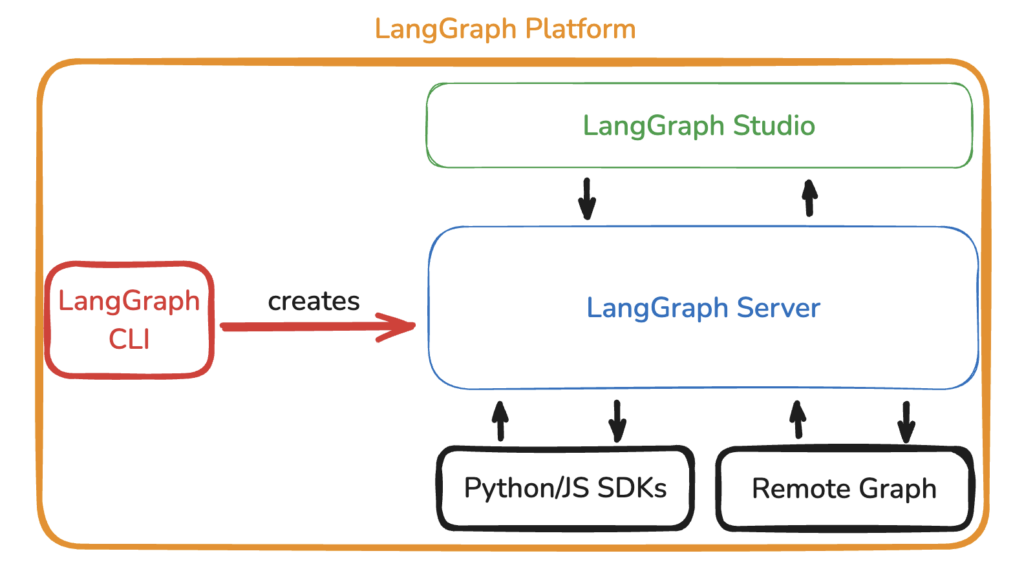
Source: LangGraph Platform Architecture
Key Features
- Open-source framework: LangGraph framework is an open-source framework provided by the LangChain team supporting agentic architecture
- Commercial platform: LangGraph Platform is a commercial solution for deploying agentic applications to production
- Stateful design: Persistent state across workflow steps with graph-based workflow orchestration
- Multi-agent capabilities: Structured agent interactions and coordination
- Native integration with LangChain: Seamless integration with the LangChain ecosystem
- Enhanced observability with LangSmith: Advanced monitoring and debugging capabilities
- IDE support: Development tools and environment integration
- Wider community support: Active community and extensive documentation
- Graph-Based Workflows:
- State Management: Persistent state across workflow steps
- Conditional Logic: Dynamic workflow paths based on conditions
- Parallel Execution: Concurrent processing of workflow branches
- Cycle Detection: Automatic loop detection and handling
Suitable for (Pros)
- Most applicable for enterprise multi-agent framework development with wider adoption as a standard and community-driven support
- Wide variety of compatibility is required with a forward-looking view of integration with different solutions or products
- Best suitable within the ecosystem of LangChain combination avoiding many frameworks in the enterprise
- Complex workflow orchestration: Ideal for applications requiring sophisticated state management and multi-step processes
- Production deployment: Commercial platform provides enterprise-grade features for production environments
Where other frameworks flare better (Cons)
- Enterprise-required features such as security, visual development, enhanced observability, etc. are supported in the commercial version
- Like LangChain, the developers have identified handling dependencies and the framework's complexity as major obstacles
- Learning curve: Requires understanding of graph-based concepts and state management patterns
- Commercial dependency: Advanced features require paid platform subscription