LangChain
Overview
LangChain is a comprehensive framework for developing applications powered by language models. It provides a unified interface for building complex agentic AI systems with tool integration, memory management, and workflow orchestration. LangChain has become a de facto standard for building AI applications with over 1M+ builders and ~100K GitHub Stars.
High-level Architecture
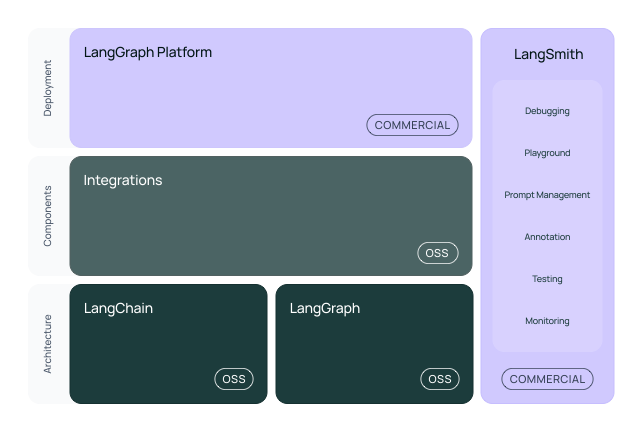
Source: LangChain Documentation
Key Features
- De facto standard: LangChain became a de facto standard for building AI Apps with 1M+ builders with ~100K GitHub Stars
- Comprehensive vendor integration: Cloud-vendor support, third-party libraries integration, diverse vector databases, and many more
- Wider community knowledge: Developer awareness makes it the most commonly used framework
- Core Components:
- LLMs and Chat Models: Unified interface for various language models
- Prompts: Template management and optimization
- Chains: Sequence operations and workflows
- Agents: Autonomous decision-making entities
- Memory: Conversation and context persistence
- Tools: External system integration
- Agent Capabilities:
- ReAct Pattern: Reasoning and Acting in language models
- Tool Use: Dynamic tool selection and execution
- Planning: Multi-step task decomposition
- Memory Management: Short and long-term context retention
- Multi-language ecosystem: Inspired similar frameworks in other languages such as LangChain4J for Java, LangChainGo for Golang, and LangChain for C#
Suitable for (Pros)
- Most applicable for enterprise development with wider adoption as a standard and community-driven support
- Building foundational building blocks of enterprise applications for GenAI—LangChain is best suited for creating enterprise-specific frameworks
- Best suitable where compatibility with third-party vendors is required with a forward-looking view of integration with different solutions or products considering the wider adoption of the LangChain framework
- Comprehensive ecosystem: Extensive tool library, integrations, and community support
- Production-ready: Mature framework with proven enterprise deployments
- Extensive documentation: Well-documented with comprehensive examples and tutorials
Where other frameworks flare better (Cons)
- Complexity and increased learning cycle with too many integrations and code complexity. For simplicity and specific purposes, other frameworks can be considered as per the context
- Continuous features/changes require developers to keep the code updated along with the possibility of breaking changes, incompatible libraries, etc.
- Performance overhead: The abstraction layers can introduce latency in performance-critical applications
- Dependency management: Heavy dependency tree can lead to version conflicts and maintenance challenges
See Also
- LangGraph
- Agent Development Frameworks
- Multi-Agent Systems
- Context Engineering
- Memory Solutions & Technology Radar — LangGraph Checkpointer/Store vs. dedicated memory vendors