AWS Strands Agents
Overview
AWS Strands Agents is an open-source multi-agent framework for building AI Agents. AWS launched Strands Agents as a model-driven, autonomous agent framework that leverages foundation models for planning, reasoning, tool selection, and execution.
High-level Architecture
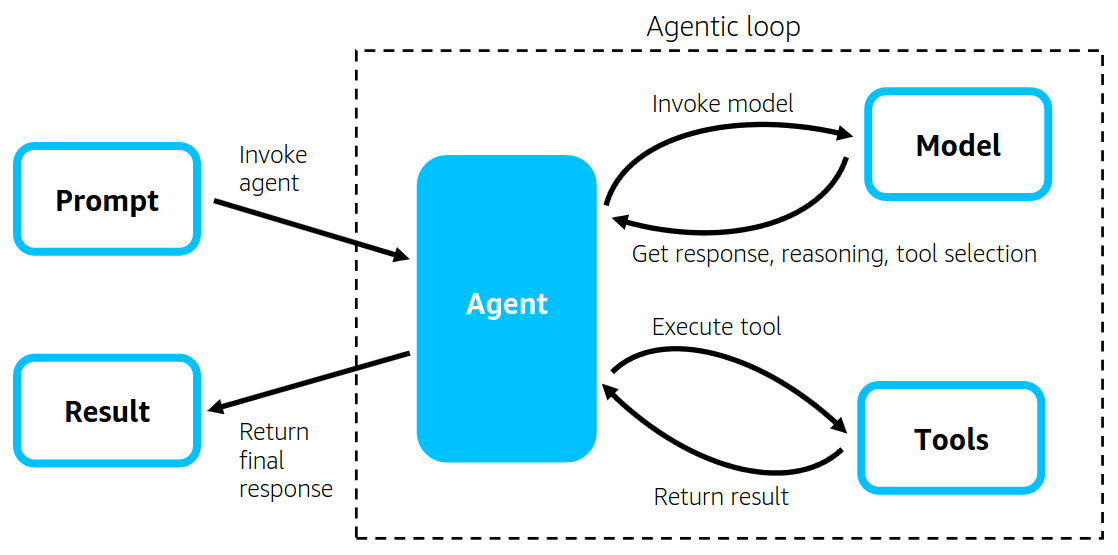
Source: Strands Agents
Key Features
- Model-driven, autonomous agent loop: Leverages a foundation model for planning, reasoning, tool selection, and execution
- Lightweight, code-first SDK: With simple Python/TypeScript APIs for agent creation and execution
- Model and provider agnostic: Supports Amazon Bedrock, OpenAI, Anthropic, Llama, and other providers via flexible interfaces
- Native AWS ecosystem integration: (e.g., AWS Lambda, Step Functions, EC2/EKS) for seamless workflows and deployment
- Tooling support via Model Context Protocol (MCP): Enabling standardized connection to external tools and resources
- Multi-agent coordination primitives: Including agents-as-tools, swarms, graphs, and meta-agents for complex workflows
- Production-ready observability: With OpenTelemetry support for tracing, logging, and metrics
- Flexible deployment targets: From local development to cloud production environments
Suitable for (Pros)
- Ideal for AWS-centric development teams seeking deep integration with cloud services and infrastructure
- Excellent choice for enterprise use cases requiring security, compliance, and controlled deployment patterns
- Strong option for autonomous agent workflows that need flexible model selection across providers
- Simplifies production readiness with observability and telemetry built into the SDK
- Supports multi-modal interactions and collaboration between agents for complex problem solving
- Offers scalable deployment paths (Lambda, Fargate, EC2/EKS, containerized environments)
Where other frameworks flare better (Cons)
- AWS ecosystem focus can feel restrictive if you want a truly cloud-agnostic or hybrid environment; other frameworks like LangGraph or AutoGen may be more neutral
- Model-first autonomous loop may introduce non-determinism that complicates debugging and reproducibility compared to frameworks with explicit orchestration logic
- Newer ecosystem with a smaller community and tooling ecosystem compared to mature open frameworks like LangChain or CrewAI
- Potential for higher development costs and complexity early on due to model-driven reasoning and reliance on LLM loops
Resources
- Official Website: strandsagents.com
- AWS Blog: Introducing Strands Agents
- GitHub Samples: Strands Agents Samples
- Code Samples and Labs: Personal Finance Assistant Lab