Agentic AI Operations (AgentOps)
This section provides comprehensive coverage of operational practices, methodologies, and frameworks for managing agentic AI systems in production environments. From Google Cloud's GenOps evolution to operational best practices, this collection offers the essential guidance needed to successfully operate AI agents at scale.
Overview
Agentic AI Operations (AgentOps) represents the evolution of traditional MLOps and DevOps practices to address the unique operational challenges of autonomous AI systems. This section covers:
- Operational Frameworks: Structured approaches to managing AI agent operations
- Platform Perspectives: Vendor-specific operational methodologies and tools
- GenOps Evolution: The transformation from MLOps to GenOps for generative AI
- Best Practices: Industry-proven approaches to agent operations
- Lifecycle Management: End-to-end operational considerations for AI agents
Google Cloud Perspective
Source: Google Cloud AgentOps Video
Google Cloud's approach to AgentOps emphasizes the integration of traditional operational practices with AI-specific considerations, focusing on:
- Autonomous System Management: Operating systems that can make independent decisions
- Human-AI Collaboration: Balancing automation with human oversight
- Scalable Operations: Managing AI agents across distributed environments
- Continuous Learning: Incorporating feedback loops for operational improvement
GenOps - Evolution of MLOps for GenAI
GenOps represents the natural evolution of MLOps (Machine Learning Operations) to address the unique challenges and opportunities presented by generative AI and agentic systems.

Key Differences from Traditional MLOps:
Traditional MLOps Focus: - Model training and deployment pipelines - Performance monitoring and drift detection - Version control for models and data - Automated retraining workflows
GenOps Expansion: - Agent Lifecycle Management: Managing autonomous agents throughout their operational lifecycle - Dynamic Behavior Monitoring: Tracking agent decision-making and adaptation - Multi-Agent Coordination: Orchestrating interactions between multiple agents - Prompt and Context Management: Versioning and optimizing agent instructions and context
Key Components of GenOps Platform
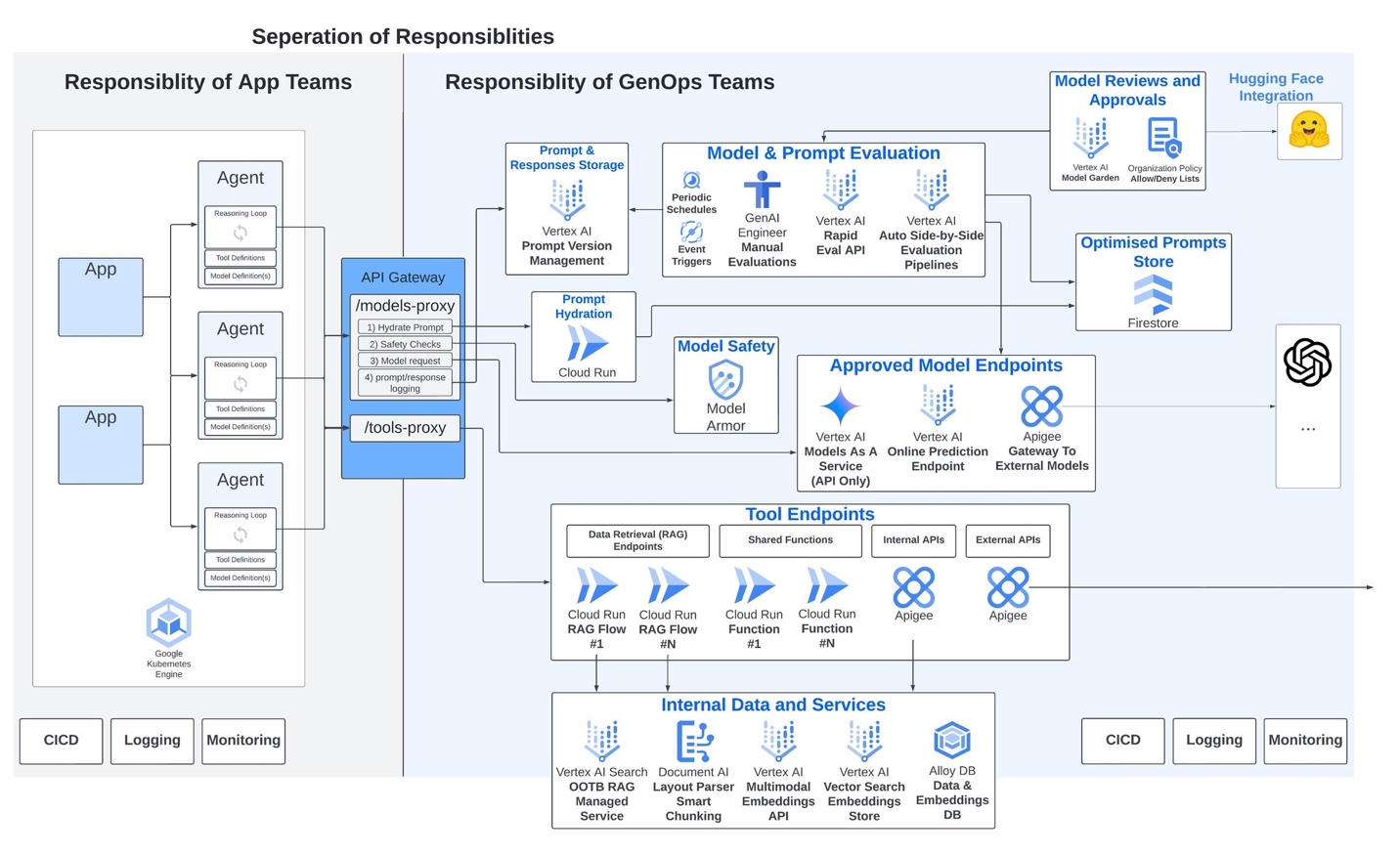
Source: Google Cloud GenOps Blog
Core Platform Components:
1. Agent Development and Deployment - Agent Authoring Tools: IDEs and frameworks for agent development - Testing and Validation: Comprehensive testing frameworks for agent behavior - Deployment Pipelines: Automated deployment and rollback capabilities - Environment Management: Staging, testing, and production environment orchestration
2. Runtime Operations - Agent Orchestration: Managing agent execution and resource allocation - Load Balancing: Distributing requests across agent instances - Auto-scaling: Dynamic scaling based on demand and performance metrics - Health Monitoring: Real-time health checks and failure detection
3. Observability and Monitoring - Behavior Analytics: Understanding agent decision patterns and effectiveness - Performance Metrics: Tracking response times, accuracy, and resource utilization - Cost Management: Monitoring and optimizing operational costs - Security Monitoring: Detecting and responding to security threats
4. Data and Context Management - Knowledge Base Management: Maintaining and updating agent knowledge sources - Context Versioning: Managing different versions of agent context and instructions - Data Pipeline Operations: Ensuring data quality and availability for agents - Privacy and Compliance: Maintaining data protection and regulatory compliance
5. Continuous Improvement - Feedback Integration: Incorporating user and system feedback into agent improvement - A/B Testing: Testing different agent configurations and behaviors - Performance Optimization: Continuous optimization of agent performance - Learning Analytics: Understanding how agents learn and adapt over time
AgentOps Implementation Framework
Operational Maturity Levels
Level 1: Basic Operations - Manual agent deployment and configuration - Basic monitoring and alerting - Simple logging and error tracking - Manual scaling and resource management
Level 2: Automated Operations - Automated deployment pipelines - Comprehensive monitoring and observability - Automated scaling and resource optimization - Basic performance analytics and reporting
Level 3: Intelligent Operations - Self-healing and adaptive systems - Predictive analytics and proactive optimization - Advanced multi-agent coordination - Continuous learning and improvement loops
Level 4: Autonomous Operations - Fully autonomous operational decision-making - Self-optimizing agent ecosystems - Advanced AI-driven operational intelligence - Seamless human-AI operational collaboration
Key Operational Processes
1. Agent Lifecycle Management
Development Phase - Agent design and architecture planning - Development environment setup and configuration - Code development and version control - Unit testing and integration testing
Testing and Validation - Behavior testing and validation - Performance benchmarking - Security and compliance testing - User acceptance testing
Deployment and Release - Automated deployment pipelines - Blue-green and canary deployment strategies - Rollback and recovery procedures - Release management and coordination
Operations and Maintenance - Runtime monitoring and management - Performance optimization and tuning - Security monitoring and incident response - Continuous improvement and updates
2. Multi-Agent Coordination
Agent Discovery and Registration - Service discovery mechanisms for agent ecosystems - Agent capability registration and advertising - Dynamic agent composition and orchestration - Load balancing and request routing
Communication and Collaboration - Inter-agent communication protocols - Shared context and knowledge management - Conflict resolution and consensus mechanisms - Workflow coordination and task distribution
Performance and Optimization - Multi-agent performance monitoring - Resource allocation and optimization - Bottleneck identification and resolution - Scalability planning and implementation
3. Operational Intelligence
Data Collection and Analysis - Comprehensive operational data collection - Real-time analytics and insights - Historical trend analysis and reporting - Predictive analytics and forecasting
Decision Support - Operational decision automation - Human-in-the-loop decision processes - Risk assessment and mitigation - Performance optimization recommendations
Continuous Improvement - Operational feedback loops - Process optimization and automation - Best practice identification and sharing - Innovation and experimentation frameworks
Best Practices for AgentOps
1. Design for Operations
Operational Considerations in Design - Build observability into agent architecture from the start - Design for scalability and distributed operations - Implement comprehensive error handling and recovery - Plan for operational maintenance and updates
Operational APIs and Interfaces - Provide comprehensive operational APIs for management - Implement standardized health check and status endpoints - Enable runtime configuration and parameter adjustment - Support operational tooling integration
2. Monitoring and Observability
Comprehensive Monitoring Strategy - Monitor both technical and business metrics - Implement distributed tracing for multi-agent systems - Track agent behavior and decision-making patterns - Monitor resource utilization and cost optimization
Alerting and Incident Response - Implement intelligent alerting with appropriate thresholds - Develop comprehensive incident response procedures - Create runbooks for common operational scenarios - Establish escalation procedures and on-call rotations
3. Security and Compliance
Operational Security - Implement comprehensive security monitoring - Regular security assessments and penetration testing - Secure operational access and authentication - Incident response and forensic capabilities
Compliance Management - Maintain compliance with relevant regulations - Implement audit trails and documentation - Regular compliance assessments and reporting - Data protection and privacy controls
4. Performance and Scalability
Performance Optimization - Continuous performance monitoring and optimization - Resource allocation and capacity planning - Load testing and performance validation - Bottleneck identification and resolution
Scalability Planning - Design for horizontal and vertical scaling - Implement auto-scaling based on demand - Plan for geographic distribution and edge deployment - Optimize for cost-effective scaling
Technology Stack for AgentOps
Core Infrastructure
Container Orchestration - Kubernetes for agent deployment and management - Docker for containerization and portability - Service mesh for inter-agent communication - Load balancers for traffic distribution
Cloud Platforms - Google Cloud Platform with Vertex AI integration - AWS with Bedrock and SageMaker integration - Microsoft Azure with Azure AI integration - Multi-cloud and hybrid deployment strategies
Monitoring and Observability Tools
Application Performance Monitoring - Datadog, New Relic, or Dynatrace for comprehensive monitoring - Prometheus and Grafana for metrics and visualization - Jaeger or Zipkin for distributed tracing - ELK stack or Splunk for log management
AI-Specific Monitoring - LangSmith for LangChain-based agents - Weights & Biases for experiment tracking - MLflow for model lifecycle management - Custom dashboards for agent-specific metrics
Deployment and CI/CD
Continuous Integration/Continuous Deployment - Jenkins, GitLab CI, or GitHub Actions for CI/CD pipelines - ArgoCD or Flux for GitOps-based deployment - Helm charts for Kubernetes deployment management - Terraform for infrastructure as code
Testing and Validation - Pytest or similar for unit and integration testing - Locust or JMeter for load testing - Custom frameworks for agent behavior testing - Security scanning and compliance validation tools
Future Trends in AgentOps
Emerging Technologies
AI-Powered Operations - AI-driven operational decision making - Predictive maintenance and optimization - Automated incident response and resolution - Intelligent resource allocation and scaling
Edge and Distributed Operations - Edge deployment of AI agents - Distributed agent coordination and management - Offline and intermittent connectivity support - Edge-to-cloud operational integration
Industry Evolution
Standardization and Interoperability - Industry standards for agent operations - Interoperable operational tooling and platforms - Common operational APIs and interfaces - Standardized operational metrics and KPIs
Regulatory and Compliance Evolution - Evolving regulatory requirements for AI operations - Compliance automation and validation tools - Audit and governance frameworks - Ethical AI operational practices
This comprehensive AgentOps framework provides the foundation for successfully operating agentic AI systems at scale, ensuring reliability, performance, security, and continuous improvement in production environments.
The AgentOps Lifecycle (Google, November 2025)
Google's "Prototype to Production" whitepaper (Nov 2025) defines the full AgentOps lifecycle as four sequential phases:
The "Last Mile" Gap
~80% of the effort in taking an agent to production is spent not on the agent's core intelligence, but on the infrastructure, security, and validation needed to make it reliable and safe. Skipping these steps leads to: - Agents tricked into giving away products or unauthorized discounts (missing guardrails) - Users accessing confidential databases (misconfigured authentication) - Large unexpected bills (no monitoring) - Critical agents going silent with no diagnostics (no continuous evaluation)
This is why an evolution in operational discipline — AgentOps — is required beyond standard DevOps/MLOps.
Phase 1: Developer Inner Loop
Rapid local testing and prototyping to shape the agent's core logic. The agent is not yet near users.
Phase 2: Pre-Production (Evaluation-Gated Deployment)
The core principle: no agent version reaches users without passing a comprehensive evaluation. Three pillars: 1. Evaluation as Quality Gate: Behavioral quality assessment of the full reasoning trajectory — not just functional tests. Uses a golden dataset; gate can be manual pre-PR or automated in-pipeline. 2. Automated CI/CD Pipeline: Three-phase funnel — CI (fast pre-merge checks + eval), CD staging (integration testing, load testing, dogfooding), CD production (human sign-off, promote validated artifact). 3. Safe Rollout Strategies: Canary (1% of users, monitor, scale up), blue-green (zero-downtime switch), A/B testing (business metric comparison), feature flags (dynamic capability release). Foundation of all: rigorous versioning across code, prompts, tool schemas, and evaluation datasets.
Phase 3: Operations in Production (Observe → Act → Evolve)
Managing autonomous agents at scale requires a continuous operational loop: - Observe: Logs (factual diary), Traces (causal narrative), Metrics (aggregated report card) - Act: Real-time levers — managing system health (performance, cost, scale) and managing risk (security response playbook: contain → triage → resolve) - Evolve: Strategic improvement — analyze production data, update evaluation datasets with failures, commit improvements to trigger the pipeline. With mature CI/CD, this loop closes in hours or days.
Phase 4: Interoperability (A2A + MCP)
At scale (dozens of specialized agents across teams), isolated agents create massive inefficiency. The solution: standardized interoperability protocols. - MCP: Universal standard for tool integration (stateless, structured I/O) - A2A: Protocol for stateful collaboration between intelligent agents (governed by the Linux Foundation)
These two protocols operate at different levels: A2A orchestrates high-level agent collaboration; each agent internally uses MCP to interact with its specific tools.
People and Process
AgentOps is the intersection of People, Processes, and Technology. Behind every production-grade agent is a well-orchestrated team:
Traditional MLOps roles: - Cloud Platform Team: infrastructure, security, access control, least-privilege roles - Data Engineering Team: data pipelines, ingestion, quality standards - Data Science and MLOps Team: experimentation, CI/CD pipeline infrastructure - ML Governance: centralized oversight, compliance, transparency, accountability
GenAI-specific additions: - Prompt Engineers: Craft prompts, define expected behavior, design evaluation criteria - AI Engineers: Scale GenAI to production, build evaluation harnesses, integrate RAG and guardrails - DevOps/App Developers: Frontend components and user-facing interfaces
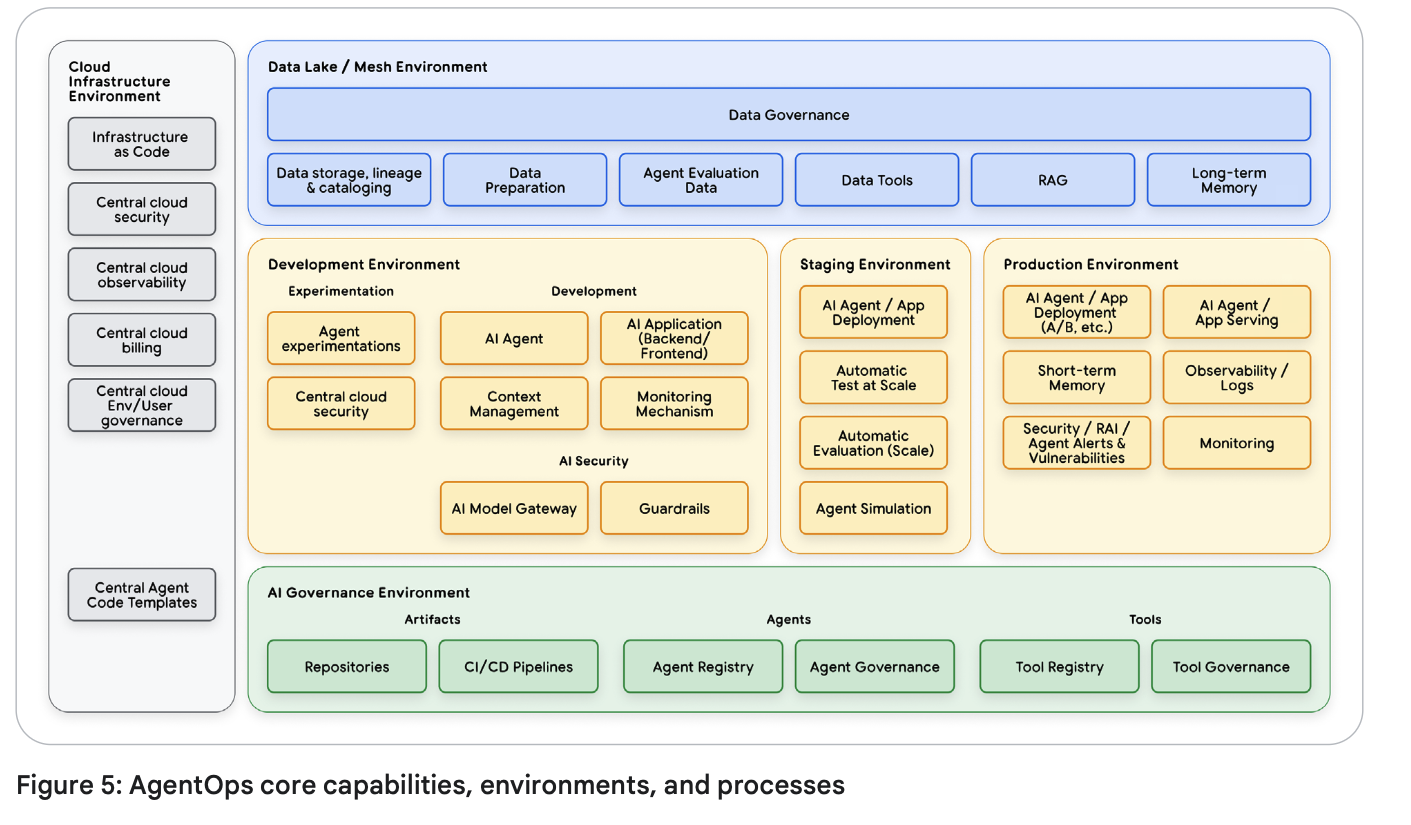
AgentOps Environments (Figure 5 Reference)
A complete AgentOps platform spans four environment types:
| Environment | Key Capabilities |
|---|---|
| Cloud Infrastructure | IaC, central security, observability, billing, env/user governance |
| Development | Agent experimentation, AI application dev, context management, AI security (model gateway + guardrails), agent simulation |
| Staging | A/B deployment, automatic testing at scale, automatic evaluation |
| Production | Agent/app serving, short-term memory, observability/logs, monitoring, security/RAI/vulnerability response |
| AI Governance | Repositories, CI/CD pipelines, Agent Registry, Agent Governance, Tool Registry, Tool Governance |
Kubernetes-Native Agent Orchestration
A distinct category of AgentOps tooling has emerged specifically for running and orchestrating agents as Kubernetes-native workloads — treating agents, tools, and models as Custom Resources managed with the same GitOps discipline as the rest of the cluster:
| Project | One-liner |
|---|---|
| kagent | CNCF Sandbox project (Solo.io); agents as Kubernetes CRDs, built on Google ADK, MCP/A2A tool and protocol integration |
| Agentic Ops Framework (AOF) | Rust-based, kubectl-style CLI and YAML spec for DevOps/SRE agents, agent fleets, and agent flows |
| KAOS (K8s Agent Orchestration System) | Independent OSS project for distributed multi-agent orchestration at scale, built on a Go control plane and Pydantic AI-based data plane |
A related, separate Kubernetes SIG Apps initiative — Agent Sandbox — standardizes isolated execution environments for individual agent tool calls via Sandbox/SandboxTemplate/SandboxClaim CRDs, rather than full agent orchestration.
AWS Perspective: Four-Pillar AgentOps Framework
AWS frames operationalizing agentic AI at scale (in the context of Amazon Bedrock AgentCore) around four pillars:
| Pillar | Focus |
|---|---|
| Governance & Security | Policy enforcement, access control, and compliance for agent identities, tools, and data access at scale |
| Build & Operations | CI/CD for agents, environment promotion, and lifecycle management of agent code, prompts, and tool configurations |
| Evaluation | Assessed at four levels: tool (did the right tool get called correctly), conversation turn (was the individual response correct), session outcome (did the overall interaction achieve the user's goal), and system (aggregate performance across all sessions) |
| Observability & Monitoring | Four telemetry layers spanning infrastructure metrics, model/inference metrics, agent reasoning traces, and business-outcome metrics |
This pillar structure parallels Google Cloud's GenOps framing above but is organized around AWS's evaluation-level taxonomy (tool → turn → session → system) rather than Google's four-phase lifecycle, and is presented specifically in the context of running agents on Bedrock AgentCore. See AWS AgentCore for the underlying managed runtime this framework operates on.
See Also
- Observability: Monitoring and observability practices
- Agent Platforms: Platform operational features
- Maturity Models: Operational maturity assessment
- ProductionBestPractices: Cross-cutting production guidance
- Standards/A2A: A2A protocol for multi-agent operations
- kagent, Agentic Ops Framework (AOF), KAOS: Kubernetes-native agent orchestration projects
- Kubernetes Agent Sandbox: SIG Apps standard for isolated agent execution environments
- AWS AgentCore: managed runtime underlying the AWS Four-Pillar AgentOps framework
- AWS — Agentic AI Overview: hub of AWS agentic AI offerings
References
- AgentOps: Operationalize agentic AI at scale with Amazon Bedrock AgentCore (AWS Machine Learning Blog) — introduces the four-pillar AgentOps framework (Governance & Security, Build & Operations, Evaluation, Observability & Monitoring)