Agent Technology Stack
Overview
The Agent Technology Stack represents the comprehensive ecosystem of platforms, tools, and frameworks that enable the development, deployment, and operation of AI agents at scale. This section provides detailed coverage of the technology landscape from foundational platforms to specialized workflow engines and popular agent implementations.
Agent Tech Stack References
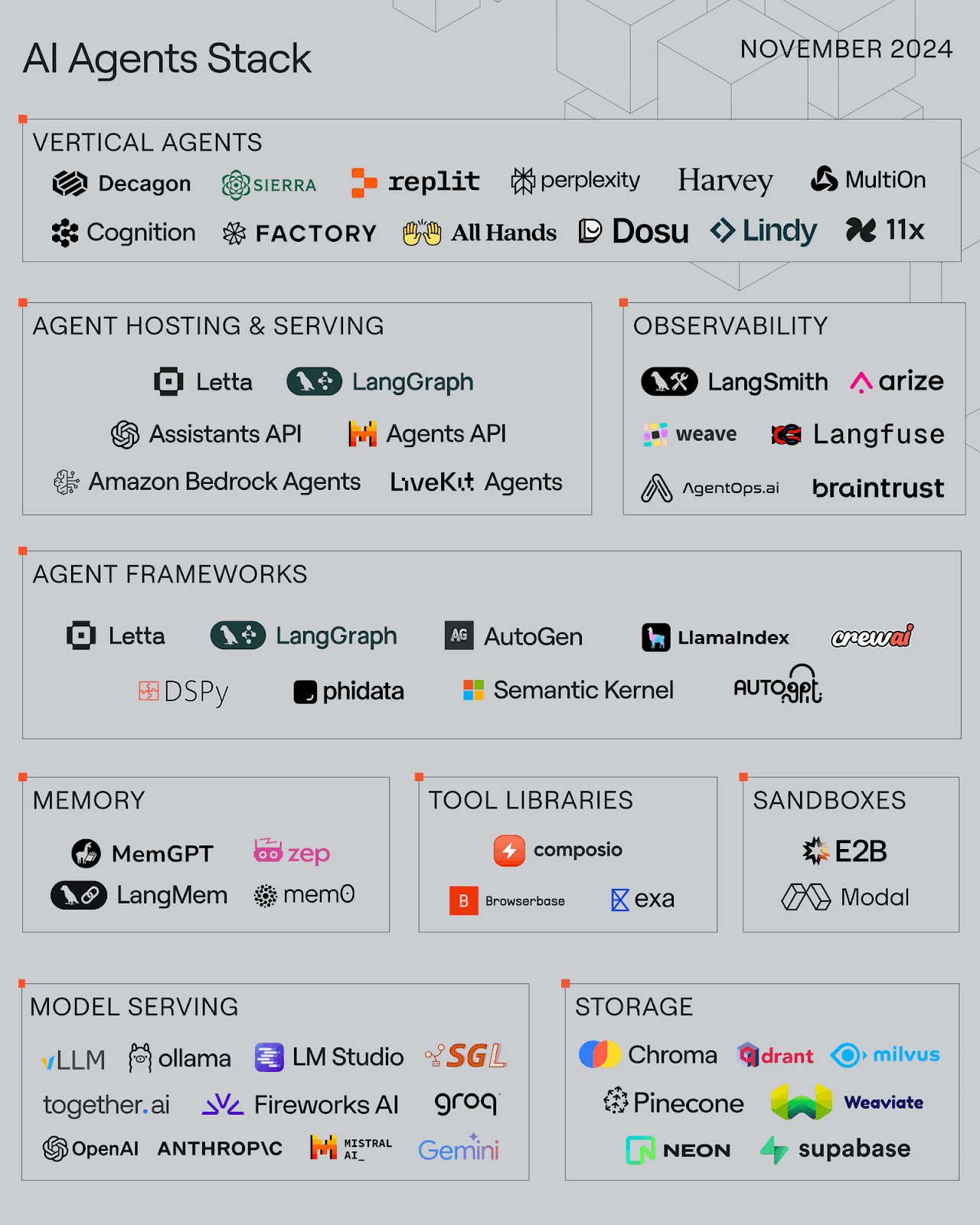
Source: Letta AI Agent Stack
The modern agent technology stack encompasses multiple layers:
- Agent Platforms: Cloud-native platforms providing comprehensive agent development and deployment capabilities
- Workflow Engines: Orchestration frameworks for building complex agent workflows
- Development Frameworks: Libraries and SDKs for agent development (covered in Section 4)
- Infrastructure: Runtime environments, memory systems, and observability tools
- Integration Layer: APIs, protocols, and connectors for external system integration
Across these layers, this wiki maintains Technology Radars that summarize ecosystem choices:
- Thoughtworks Tech Radar (Vol. 34, Apr 2026): Agentic AI Digest — 118-blip industry radar with full agentic AI coverage (Section 5.1.1)
- Semantic Data Layer Radar: Semantic Data Layer Technology Radar — cloud-native (Snowflake Semantic Views, Databricks Metric Views, Power BI/Fabric, QuickSight Topics, Looker) vs. universal semantic layers (dbt Semantic Layer, Cube, AtScale, Denodo, Honeydew) and the emerging Open Semantic Interchange (OSI) standard (Section 5.1.2)
- Frameworks Radar: Agentic Framework Solutions (Section 4.16)
- Agent Platforms & Stack: Platform coverage in this section (5.2) plus vendor deep dives in Section 5 and 18
- Observability Radar: Agent Observability Tech Radar (Section 12.4)
Key Components
Platform Layer
- Google Vertex AI Agent Builder: Enterprise-grade agent development platform
- AWS AgentCore: Scalable agent deployment and operation platform
- Microsoft Azure AI Agent Service: Integrated agent services within Azure ecosystem
- Third-party SaaS Platforms: Specialized agent platforms and marketplaces
Infrastructure and Hosting
- AWS: GenAI Foundation with AWS provides comprehensive infrastructure for generative AI applications

- GPU Hosting: Lambda.ai offers NVIDIA H100, A100 & more Tensor Core GPUs available on-demand in a public cloud for high-performance agent workloads
Caching and Performance
- Semantic Caching: Redis LangCache - A fully-managed semantic cloud caching service that reduces large language model (LLM) costs and improves response times for AI applications
LLM (AI) Gateway
- AISuite: AISuite by Andrew Ng - Simple, unified interface to multiple Generative AI providers
- Arch Gateway: Arch Gateway - An AI-native Gateway built on top of Envoy providing request clarification, query routing, and data extraction
Code Execution and Sandboxes
Agents' ability to spin up fully-isolated environments to safely execute AI-generated and untrusted code at scale.
Managed Sandboxes
- Koyeb Sandbox: Koyeb Sandboxes - Fast, scalable, fully isolated environments for AI agents and workflows, executing untrusted or user-generated code securely, prototyping applications quickly, testing APIs or libraries in clean environments
Web Search and Data Extraction
- AgentQL: AgentQL.com - Query language and Playwright integrations for interacting with elements and extracting data quickly
Context Engines for Coding Agents
- Unblocked: getunblocked.com - AI "context engine" that indexes a codebase alongside its documentation, tickets, and team conversations into a knowledge graph, surfaced to coding agents and developers via Slack, terminal, web, and MCP. Raised a $20M Series A; positions itself as the missing institutional-knowledge layer that pure code-search tools lack — answering "why" a piece of code exists, not just "what" it does.
Agent Communication Infrastructure
- Novu: github.com/novuhq/novu - Open-source Agent Communication Infrastructure (ACI) providing a unified conversation model that connects any agent to messaging surfaces — Slack, Microsoft Teams, Telegram, WhatsApp, email, and an in-app inbox — without each agent needing bespoke integration code per channel.
Orchestration Layer
- Open Source Workflow Engines: MIT/Apache licensed orchestration frameworks
- Self-hosted Solutions: Enterprise-controlled workflow platforms
- Business Process Integration: Workflow engines designed for enterprise processes
- No-code Solutions: Visual workflow builders for non-technical users
Agent Ecosystem
- Coding Agents: Specialized agents for software development tasks (Claude Code, Cursor, OpenCode, OpenAI Codex)
- Research Agents: Agents focused on information gathering and analysis
- Personal AI Agents: Self-improving, persistent agents with cross-session memory — see Hermes Agent (Nous Research) as a leading OSS example
- Super Agents: General-purpose agents capable of complex multi-domain tasks
- Domain-specific Agents: Agents tailored for specific industries or use cases
Navigation
This section is organized into the following subsections:
- 5.2 Agentic AI Platforms: Comprehensive coverage of major cloud platforms and SaaS solutions
- 5.3 Workflow Engine/Frameworks: Detailed analysis of orchestration and workflow tools
- 5.4 Popular AI Agents: Survey of notable agent implementations across different categories
Each subsection provides detailed technical analysis, architecture diagrams, and practical guidance for selecting and implementing the appropriate technology stack components for your agentic AI initiatives.
Integration with Other Sections
The Agent Technology Stack closely integrates with: - Section 4: Agent Development Frameworks (the development layer) — see the Agentic Framework Solutions Tech Radar for framework selection - Section 6: Industry Standards (protocols and interoperability) - Section 11: Security (platform security considerations) - Section 12: Observability (monitoring and operations) — see the Agent Observability Tech Radar for tooling and platform choices
Search and Vector Databases
- PageIndex AI: vectorless, reasoning-based retrieval framework
Memory and Context Management
Dedicated infrastructure for agent memory — persisting context across sessions, managing retrieval, and unifying memory with skills and resources.
| Tool | Type | Open Source | Radar Rating | Notes |
|---|---|---|---|---|
| OpenViking | Hierarchical context database (filesystem paradigm) | Yes (Apache 2.0) | 🟡 Assess | ByteDance/Volcano Engine; unifies memory, resources, skills via L0/L1/L2 tiering; ~80% token reduction vs. flat RAG |
| Mem0 | Memory layer + managed API | Yes (Apache 2.0) | 🟢 Adopt | ~54K stars; semantic + episodic; most widely adopted |
| Graphiti (Zep) | Temporal knowledge graph | Yes (Apache 2.0) | 🟢 Adopt | ~25K stars; bi-temporal data model |
| Letta (MemGPT) | Stateful agent runtime | Yes (Apache 2.0) | 🔵 Trial | OS-inspired working memory; ~21K stars |
| Supermemory | Memory API + Memory Router | Yes (MIT) | 🔵 Trial | Sub-300ms recall; transparent context injection |
| Redis Agent Memory Server | Session + semantic memory | Yes (MIT) | 🔵 Trial | Official Redis project; working + LTM in one store |
For full radar assessments, decision criteria, and selection guidance see Agent Memory Solutions.
See Also
- Semantic Data Layer Technology Radar: Radar for cloud-native and universal semantic data layer products
- Agent Memory Solutions Radar: Full radar for memory and context management tooling
- Agent Development Frameworks: Development tools and frameworks
- Frameworks Technology Radar: Technology radar for development frameworks
- Agent Platforms: Cloud and SaaS platform options
- Observability: Monitoring and observability solutions
- Observability Tech Radar: Technology radar for observability tools and platforms
- Security Frameworks: Security considerations for tech stacks
References
- Unblocked — AI context engine indexing codebase, docs, tickets, and conversations into a knowledge graph
- Novu — GitHub — Open-source Agent Communication Infrastructure connecting agents to messaging channels