Agentic AI Maturity Models
Overview
Agentic AI maturity models provide frameworks for organizations to assess their current capabilities and plan their journey toward advanced AI agent implementations. These models help enterprises understand the progression from initial experimentation to large-scale, production-ready agentic systems.
This section consolidates maturity perspectives from leading industry analysts and cloud providers, offering comprehensive guidance for organizations at different stages of their agentic AI journey.
Key Maturity Dimensions
Across different maturity models, several common dimensions emerge:
Technical Maturity
- Infrastructure Readiness: Cloud-native architecture and scalable compute resources
- Platform Capabilities: Comprehensive development and deployment platforms
- Integration Capabilities: Seamless integration with existing enterprise systems
- Security and Governance: Robust security controls and compliance frameworks
Organizational Maturity
- Skills and Expertise: AI/ML capabilities and agent development expertise
- Process and Governance: Established processes for agent lifecycle management
- Culture and Change Management: Organizational readiness for AI-human collaboration
- Strategic Alignment: Clear business objectives and success metrics
Operational Maturity
- Monitoring and Observability: Comprehensive tracking of agent performance
- Quality Assurance: Testing frameworks and quality control processes
- Scalability: Ability to handle enterprise-scale deployments
- Continuous Improvement: Mechanisms for ongoing optimization and innovation
Maturity Assessment Benefits
Organizations benefit from maturity assessments by:
- Strategic Planning: Clear roadmap for agentic AI adoption and scaling
- Resource Allocation: Informed decisions about investments and priorities
- Risk Management: Identification and mitigation of implementation risks
- Capability Building: Targeted development of necessary skills and processes
- Performance Measurement: Benchmarking progress and success metrics
Industry Perspectives
Gartner's Perspective
Focuses on strategic and organizational readiness for agentic AI adoption, emphasizing governance, risk management, and business value realization.
AWS's Perspective
Provides a practical four-level maturity model (Envision, Experiment, Launch, Scale) with detailed implementation guidance and technical considerations.
Google's Perspective
Emphasizes technical capabilities, platform integration, and systematic approaches to agent development and deployment.
IDC's Perspective
Analyzes the evolution of enterprise applications toward agentic capabilities and the organizational transformation required.
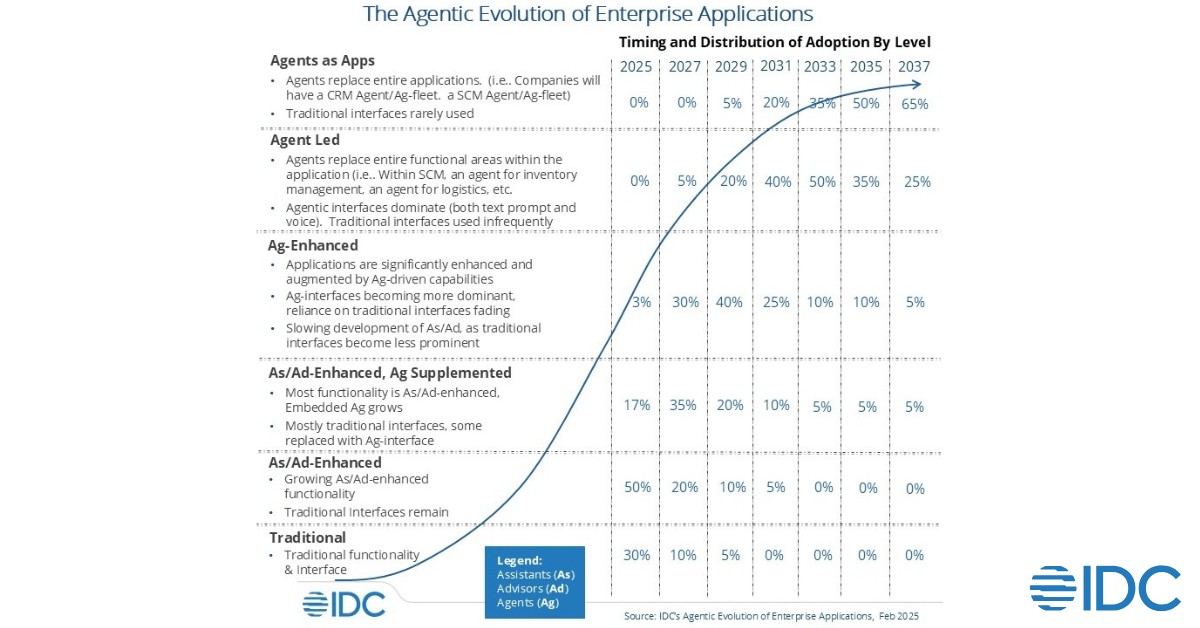
IDC's perspective on the agentic evolution of enterprise applications showing the progression from traditional applications to fully agentic systems
Dataiku's Perspective
Dataiku frames enterprise AI transformation as a five-phase maturity journey — Explore (early experimentation, finding internal adopters), Experiment (testing AI value with first projects), Establish (proving tangible value from initial use cases, laying foundations to scale), Expand (broadening AI usage across the organization), and Embed (AI woven into every activity as part of organizational DNA). This phase model separates sustained transformation from stalled pilot programs, with the Establish→Expand transition flagged as the point most organizations stall. Dataiku pairs this with an operating-model maturity axis (Decentralized/Siloed Teams → Centralized Center of Excellence → Hub and Spoke, where a central hub owns infrastructure/governance while business units drive product development) and a separate five-stage governance maturity model (ad hoc → documented → operationalized → integrated → adaptive).
Getting Started with Maturity Assessment
Organizations beginning their agentic AI journey should:
- Assess Current State: Evaluate existing AI/ML capabilities and infrastructure
- Define Target State: Establish clear goals and success criteria
- Identify Gaps: Determine areas requiring investment and development
- Create Roadmap: Develop phased approach to capability building
- Implement Governance: Establish frameworks for risk management and compliance
- Measure Progress: Define KPIs and tracking mechanisms
Cross-References
- Section 3: Architecture & Design Patterns - Technical foundation considerations
- Section 4: Agent Development Frameworks - Implementation tools and platforms
- Section 11: Agentic AI Security - Security and governance frameworks
- Section 16: AI Agents Best Practices - Implementation guidance from industry leaders
Resources
- Gartner Research on AI Agent Maturity
- AWS Generative AI Maturity Model
- IDC: The Agentic Evolution of Enterprise Applications
- Google Cloud AI Maturity Resources
- Arsanjani GenAI Maturity Model — 7-level framework (Levels 0–6) mapping data foundation → RAG → tuning → grounding → single-agent → multi-agent; maps each level to design patterns and includes the Agentic AI Maturity Spectrum (6 sub-levels for Levels 5–6)
- Dataiku: Enterprise AI transformation — five-phase maturity journey (Explore/Experiment/Establish/Expand/Embed), operating-model maturity axis, and five-stage governance maturity model
See Also
- Evaluation Frameworks: Assessment and evaluation approaches
- Best Practices: Maturity-driven best practices
- Agent Ops: Operational maturity considerations
- Standards: Standards compliance and maturity